
November 5, 2026
New Brunswick 2025–2026: An In-Depth Report on the Macroeconomy and Industry
New Brunswick's economy is at a turning point of slowing growth and structural change: real GDP grew 1.2% in 2024 to about C$48.5 billion, unemployment hit 7.7% in May 2025, and 92% of exports go to the United States. This report examines the province's macroeconomy, industries, regions, trade, labour market, finances and outlook for 2025–2026.
Condensed Version
Short on time? Read this condensed version instead of the full article.
New Brunswick's economy is at a critical stage where slowing growth runs alongside structural transformation.
Real GDP grew 1.2% in 2024, to a total of about C$48.5 billion, and growth in 2025 is expected to be only 0.7%–1.1%. In May 2025, the provincial unemployment rate climbed to 7.7%, its highest since 2020. Population grew to 854,355 in 2024, up 2.7% year over year, but the age structure still faces pressure from an aging population.
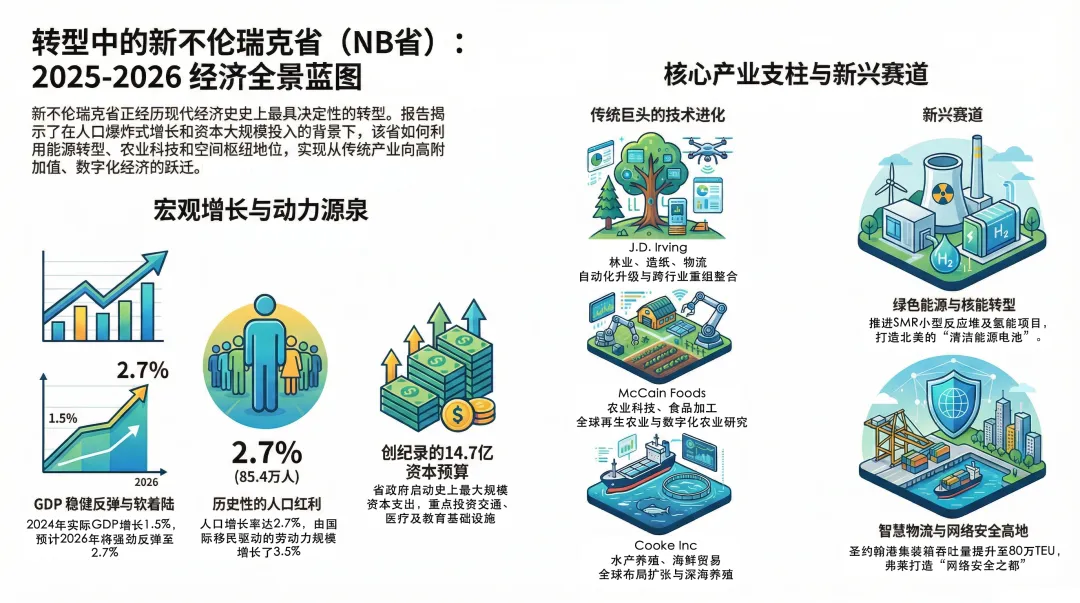
The core industrial structure is changing: traditional forestry, fisheries and agriculture are moving toward intensive processing, digitalization and green energy; emerging industries such as information and communications technology (ICT), digital health and cybersecurity are rising, with Moncton and Fredericton becoming the engines of growth; the Irving Group and McCain Foods remain the pillars of the provincial economy, and energy transition and export diversification are the keys to the future.
The core challenges include: heavy dependence on the U.S. market for exports (92% of export value), heavily affected by the Trump administration's tariff policies; a shortage of housing supply and tight medical resources; labour shortages, an aging population, and uneven regional development.
Conclusion: despite multiple pressures from tariffs, labour, housing and more, New Brunswick still has long-term growth potential thanks to its demographic dividend, bilingual advantage, energy resources and digital economy.
Full Article
Introduction
New Brunswick, an important province on Canada's Atlantic coast, is at a critical juncture in 2025–2026 where economic transformation meets external shocks. Facing global trade tensions, domestic demographic change and pressure to upgrade its industries, the province's economic performance shows the characteristics of "slowing growth, structural adjustment and regional divergence."
This report draws on official economic data from the Government of New Brunswick, Statistics Canada data and reports from international research institutions to systematically analyze the province's macroeconomic performance, industrial structure, regional development, trade patterns, labour market, fiscal situation and future outlook in 2025–2026.
Chapter 1: The Macroeconomic Picture
1.1 Overview of Economic Development
New Brunswick's economy ranks near the bottom among Canadian provinces by size, but in recent years it has shown steady growth.
According to data from the Government of New Brunswick and Statistics Canada:
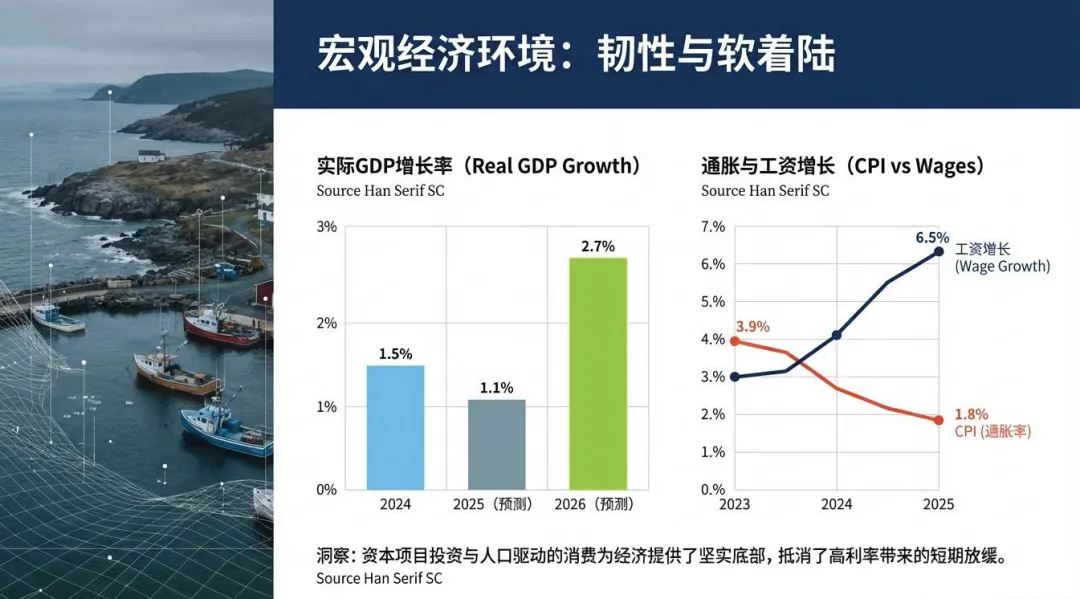
- Real GDP grew 1.2% in 2024, to a total of about C$48.5 billion;
- Growth in 2025 is expected to be 0.7%–1.1%, slower than in 2024;
- Nominal GDP in 2024 was about C$50 billion.
The main drivers of economic growth are consumption expansion brought by population growth, construction investment, public-sector spending and the recovery of export demand.
1.2 Key Economic Indicators
Looking at the core macroeconomic indicators, the province's economy in 2025 shows the following characteristics:
- Rising unemployment: in May 2025, the provincial unemployment rate climbed to 7.7%, its highest since 2020. This reflects the reality of a slowing economy and mounting pressure in the labour market.
- Inflation: in May 2025, the Consumer Price Index (CPI) rose 2.3% year over year, slightly below the national average. Rising food prices and housing costs were the main drivers.
- Strong population growth: as of July 1, 2024, the provincial population was estimated at 854,355, up 2.7% year over year (an increase of 22,165 people), the third consecutive year of growth above 2.0%.
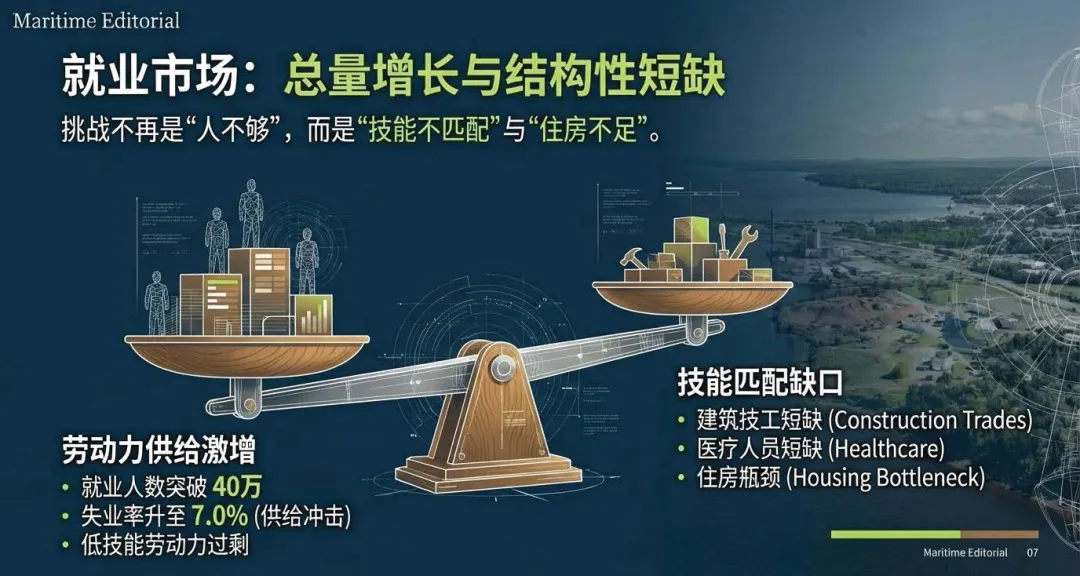
In May 2025, New Brunswick's unemployment rate climbed to 7.7%.
1.3 Regional Economic Divergence
Economic development within New Brunswick shows clear regional divergence:
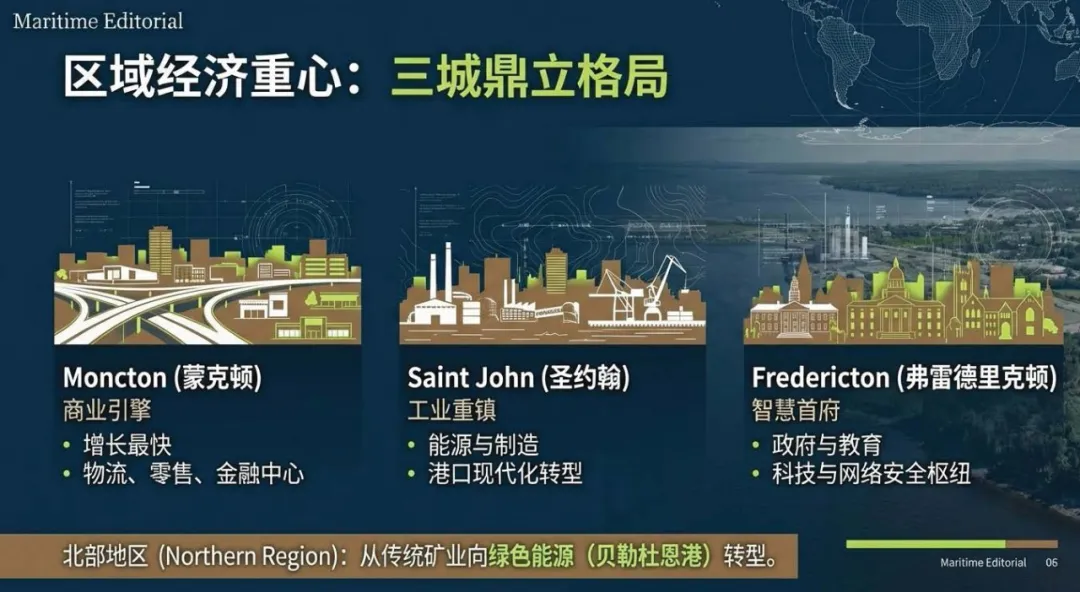
Moncton: the province's engine of economic growth, with population growth of 7.0% in 2024, reaching 98,208 people. As the province's largest city, Moncton has become a logistics, call-centre and fintech hub thanks to its geographic advantage (at the centre of the province) and its bilingual workforce.
Fredericton: the provincial capital, with population growth of 4.3%, reaching 77,736 people. As the seat of government and an education centre, Fredericton has the province's highest per-capita income and education levels, and its cybersecurity and technology-innovation industries are booming.
Saint John: the province's industrial centre, with population growth of 3.9%, reaching 78,165 people. The expansion of the Port of Saint John and the transformation of the energy industry are key to the city's economic development.
Chapter 2: Industrial Structure and Transformation
2.1 Traditional Industries: Transformation and Challenges Side by Side
Traditional industries remain the bedrock of New Brunswick's economy, but they are undergoing profound transformation.
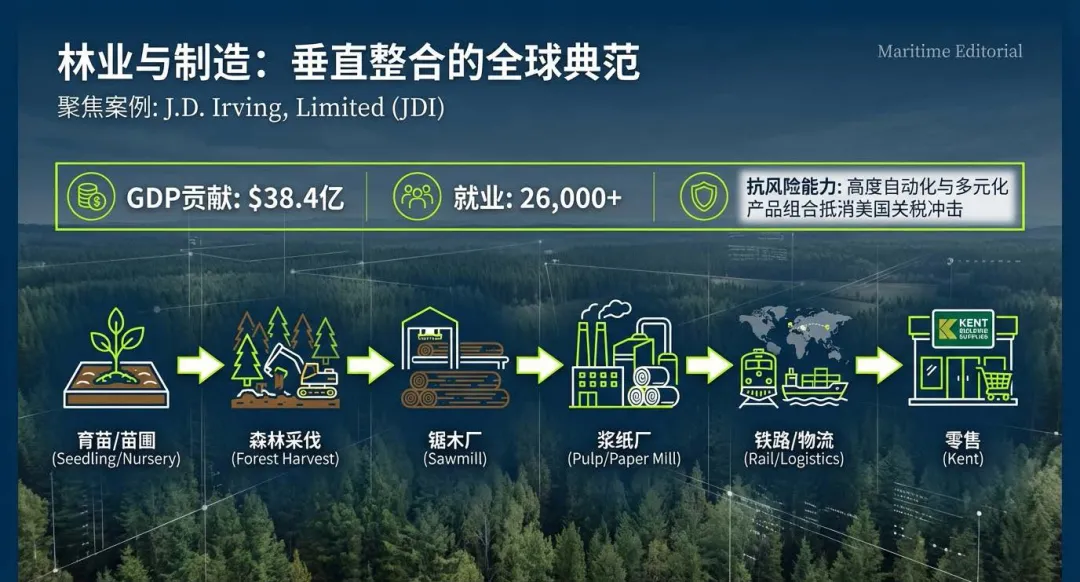
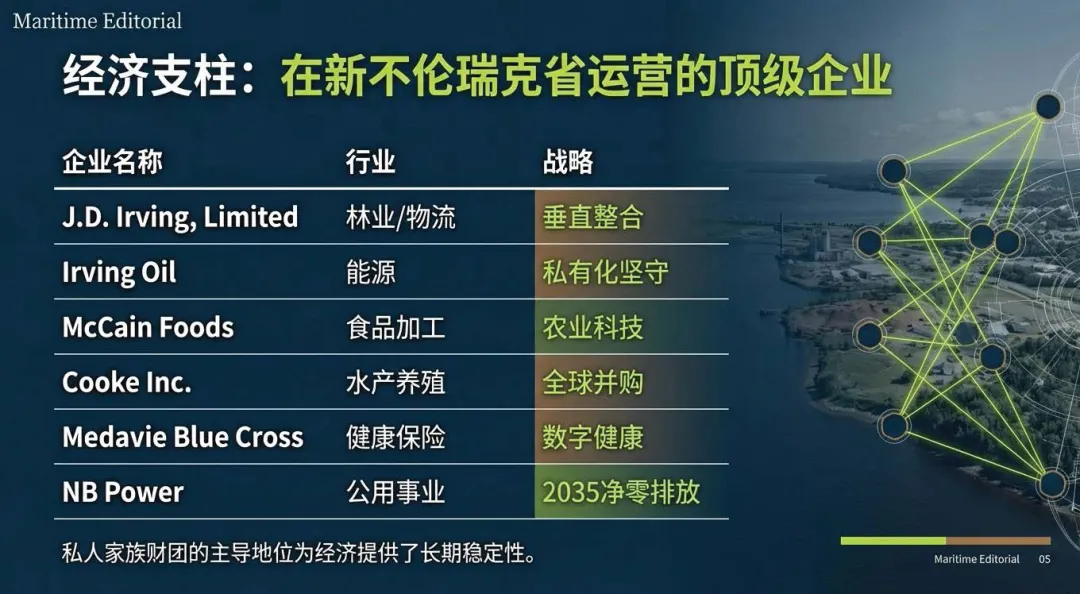
Forestry: with forest cover as high as 83%–85%, forestry is the province's oldest sector with the most complete value chain. From pulp and paper to wood processing, the industry is extremely export-dependent. J.D. Irving controls most of the province's private forest land and stays competitive in international pulp and paper markets through highly automated forest management. However, Crown land management rights, herbicide use and Indigenous land rights continue to spark controversy.
Fisheries: New Brunswick is one of the world's major Atlantic salmon farming regions, concentrated mainly in the Bay of Fundy. At the same time, lobster and snow crab fishing on the Acadian Peninsula is the economic lifeline of local communities, with products exported in large volumes to the United States and Asian markets.
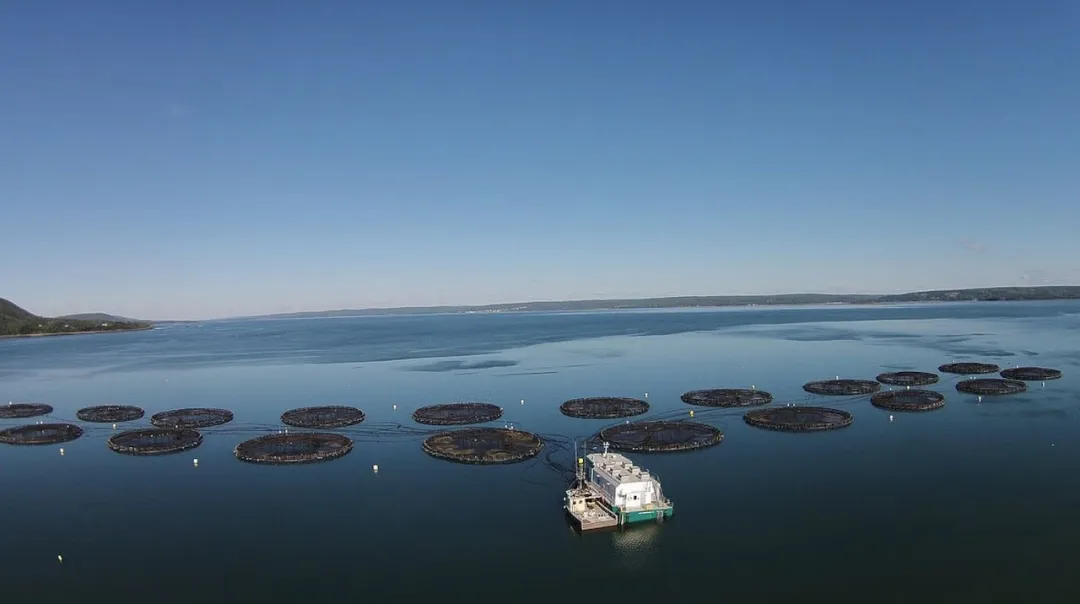
The Kelly Cove salmon farm is located in Digby, Nova Scotia. A Cooke subsidiary is seeking to expand operations in the area.
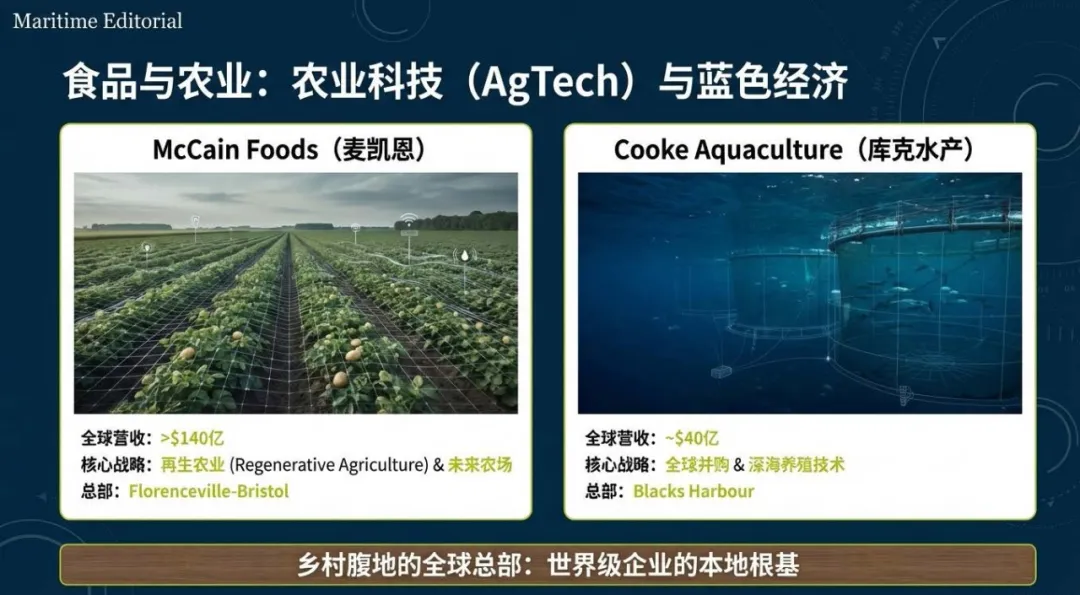
Agriculture: the upper Saint John River valley (Carleton and Victoria counties) has calcium-rich soils and is a world-class producer of seed potatoes and processing potatoes. McCain Foods was founded in Florenceville in 1957 and is now the world's largest producer of frozen french fries — one in every three frozen fries consumed worldwide comes from McCain.
2.2 Emerging Industries: The Rise of the Digital Economy
Information and communications technology (ICT): Fredericton has built a thriving cybersecurity ecosystem around the University of New Brunswick (UNB). The Canadian Institute for Cybersecurity (CIC) has attracted giants such as Siemens and IBM to set up research and development centres there, focused on protecting critical infrastructure.

Digital health: New Brunswick is advancing virtual care and collaborative care clinics to address the problem of tens of thousands of residents without a family doctor.
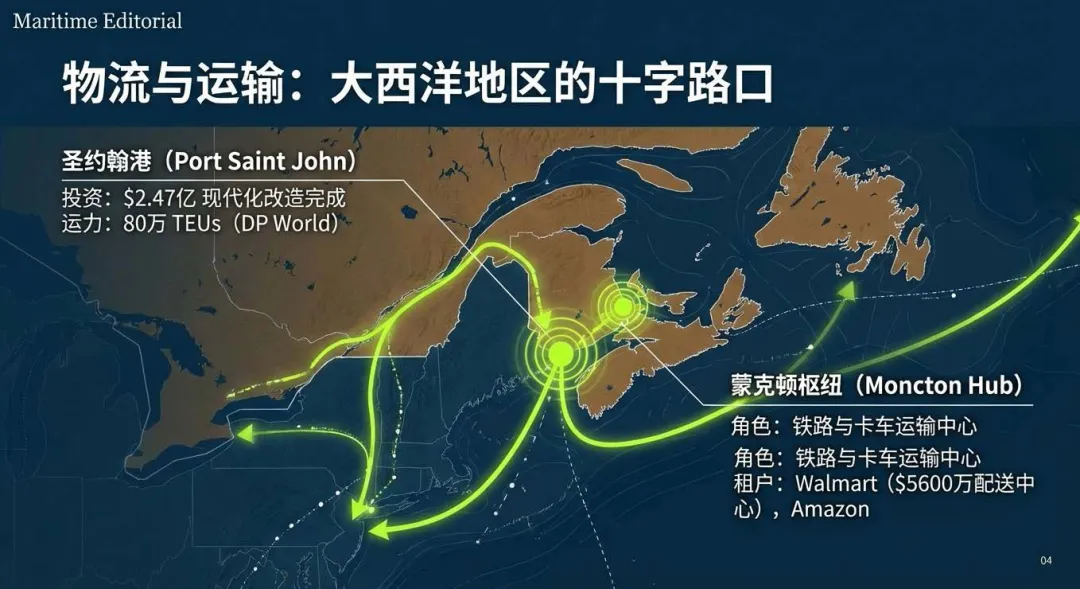
E-commerce and logistics: thanks to its railway-hub status and bilingual advantage, Moncton has become an important North American logistics and call-centre hub.
2.3 Energy: A Key Sector in Transition
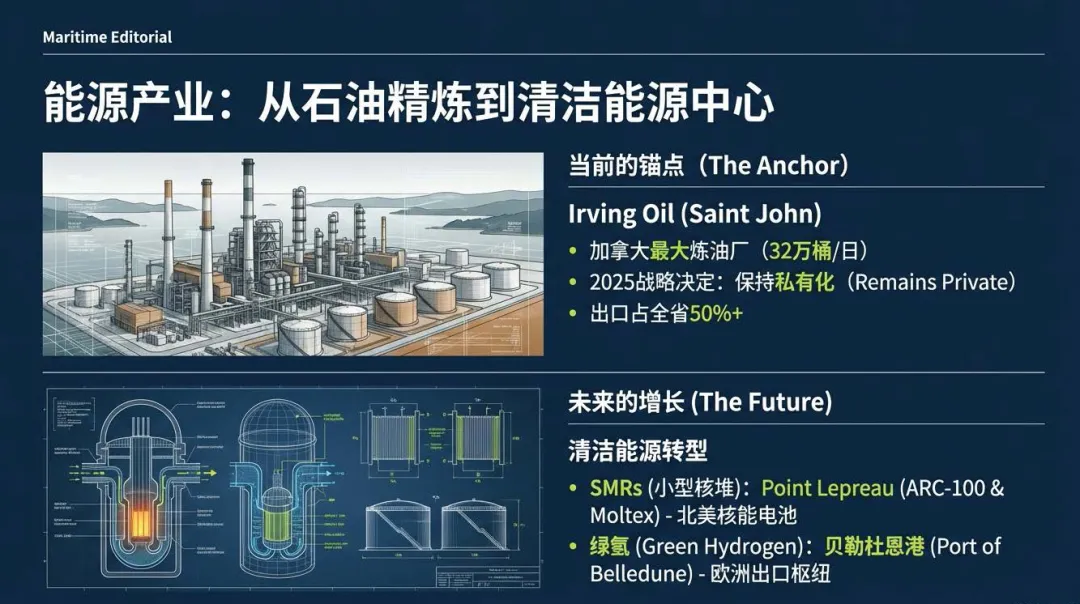
Nuclear energy: New Brunswick is seeking to position itself as a global centre for the research, development and export of small modular reactor (SMR) technology. The provincial government supports two startups, ARC Clean Technology and Moltex Energy, in developing fourth-generation nuclear technology at the existing Point Lepreau Nuclear Generating Station site, with the goal of commercial operation in 2030–2035.
Renewable energy: the Neweg Energy Project, near Sussex, is a 25-megawatt wind project jointly owned by the Mi'gmaq United Investment Network and developer Natural Forces. It is a model of Indigenous peoples moving from "stakeholders" to "asset owners".
Petroleum refining: the Saint John refinery operated by Irving Oil is Canada's largest refinery, producing more than 320,000 barrels per day and supplying most of the gasoline for the northeastern United States.
Chapter 3: Trade Patterns and External Shocks
3.1 Export Structure
New Brunswick's economy is highly export-dependent. Its main exports include:
- Refined petroleum: the largest share of total exports;
- Wood and wood products: forestry exports;
- Seafood: lobster, snow crab and salmon;
- Potato products: frozen french fries and other processed foods;
- Pulp and paper.
3.2 Dependence on the United States and the Tariff Shock
New Brunswick's exports are extremely dependent on the U.S. market, with about 92% of exports going to the United States. This heavy dependence makes the province extremely vulnerable to changes in U.S. trade policy.
In 2025, the tariff policies implemented by the Trump administration had a significant impact on New Brunswick's economy:
- Lumber tariffs: U.S. tariffs on Canadian lumber directly affect New Brunswick's forestry exports;
- Energy tariffs: tariffs on refined petroleum products threaten Irving Oil's export business;
- Agricultural tariffs: potato products and seafood face tariff barriers.
In response to the tariff shock, the Government of New Brunswick and businesses are actively promoting export diversification, developing European and Asian markets.
3.3 Interprovincial Trade and the Internal Market
New Brunswick's trade with other Canadian provinces is also growing, particularly in agricultural products, forest products and energy. Growth in interprovincial trade helps reduce dependence on the U.S. market.
Chapter 4: Labour Market and Demographics
4.1 Population Growth and Structural Change
According to a report published by the Government of New Brunswick in 2025, as of July 1, 2024, the provincial population was estimated at 854,355, up 2.7% year over year (an increase of 22,165 people). This is the second-highest growth rate on record since 1971, and the third consecutive year of growth above 2.0%.
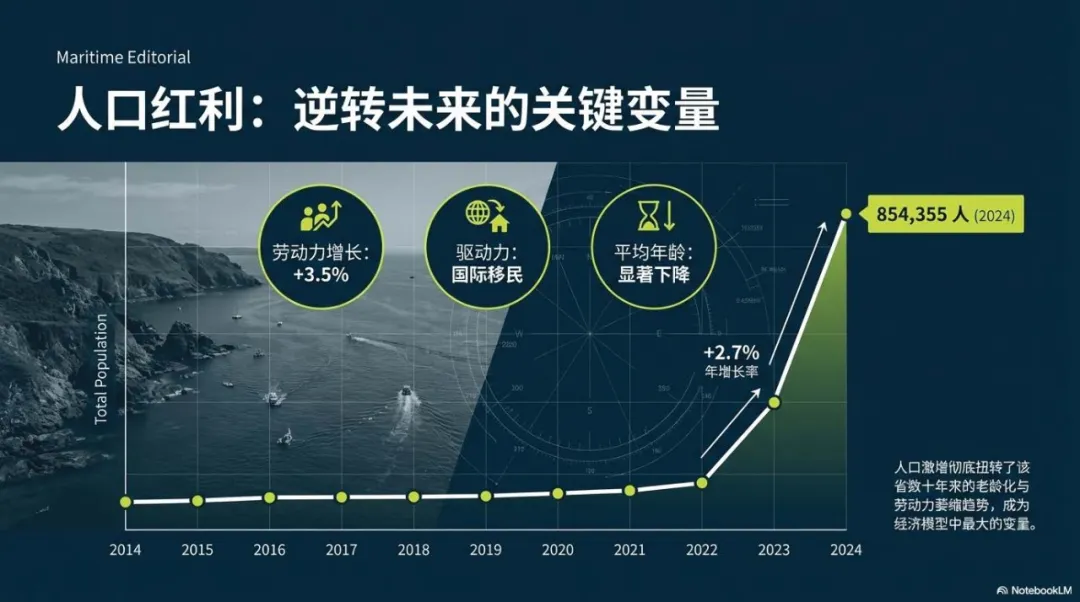
This growth is driven entirely by immigration:
- International immigration: in 2023–2024, the province gained a net 22,724 international immigrants, becoming the absolute engine of population growth.
- Interprovincial migration: historically, New Brunswick was a net exporter of population, but in recent years it has turned a profit. As housing costs rise in places like Ontario, large numbers of Canadians (mainly young people and young families) have moved east to New Brunswick; in 2023–2024, net inflow from Ontario was 3,725 people.
4.2 The Aging Challenge
Despite the influx of immigrants, aging remains the core challenge. The province's median age is 44.8 years — down from 46.3 in 2021, but still high. Deaths have exceeded births for ten consecutive years (6,215 births and 9,577 deaths in 2023–2024), which means that without immigration, the province's population would shrink naturally.
4.3 Labour Market Conditions
- Unemployment: the unemployment rate reached 7.7% in May 2025, reflecting the economic slowdown;
- Labour shortages: health care, construction and information technology face severe labour shortages;
- Wage growth: average hourly wages are rising, but remain below the national average;
- Youth employment: the youth unemployment rate is high, and the brain drain problem persists.
Chapter 5: Fiscal Situation and Public Policy
5.1 Fiscal Revenue and Expenditure
New Brunswick has long been classified as a "have-not province", heavily reliant on federal equalization payments to maintain public-service standards.
- The 2025–26 budget is projected to run a deficit of about C$600 million;
- Net debt as a share of GDP is expected to rise to 28.5% in 2028–29;
- The surge in health-care spending (a large share of the budget) and debt-servicing costs are the greatest threats to fiscal health.
5.2 Public Policy Priorities
After the 2024 provincial election, Liberal leader Susan Holt became the province's first woman premier. Her government's policy priorities include:
- Health-care reform: advancing virtual care and collaborative care clinics;
- Education investment: closing "ultra-small schools" with fewer than 100 students to consolidate resources;
- Housing policy: increasing housing supply to cope with the pressure of population growth;
- Energy transition: supporting the development of SMR nuclear technology.
Chapter 6: Regional Development and Urban Economies
6.1 Moncton: The Growth Engine
Moncton is New Brunswick's most dynamic commercial engine and its only bilingual urban centre. Leveraging its geographic centrality and railway-hub advantage, it has vigorously developed logistics and call-centre industries. Today it has transformed into a retail and fintech centre. The Université de Moncton is the cradle of Acadian intellectuals.
6.2 Saint John: Industrial Transformation
Saint John is Canada's oldest incorporated city and its industrial heart. The Port of Saint John has just completed a C$247 million West Side Modernization Project, raising container throughput capacity to 800,000 TEU (twenty-foot equivalent units). The expansion allows it to berth post-Panamax mega-vessels and reach North American inland markets directly by rail, aiming to challenge the port status of Halifax and Montreal.
6.3 Fredericton: The Smart City
Fredericton is the seat of government and an education centre, with the province's highest per-capita income and education levels. Beyond government departments, its economy is increasingly driven by technology startups spun out of UNB. The annual Harvest Music Festival in September is its cultural calling card, attracting tens of thousands of visitors.
Chapter 7: Challenges and Opportunities
7.1 Key Challenges
- Tariff shock: high dependence on exports to the United States, heavily affected by the Trump administration's tariff policies;
- Housing shortage: rapid population growth has led to insufficient housing supply and rising house prices;
- Health-care pressure: a shortage of family doctors puts enormous pressure on the health-care system;
- Labour shortages: key industries face recruitment difficulties;
- Regional imbalance: the urban–rural development gap persists;
- Fiscal pressure: rising deficits and debt levels.
7.2 Development Opportunities
- Demographic dividend: immigration growth brings labour and consumer demand;
- Digital economy: cybersecurity and ICT industries are growing rapidly;
- Energy transition: SMR nuclear technology could become a new growth driver;
- Port expansion: the modernization of the Port of Saint John enhances trade capacity;
- Bilingual advantage: Canada's only officially bilingual province, attracting investment and talent;
- Indigenous economy: Indigenous peoples have moved from litigation to equity participation, becoming an important force in economic development.
Chapter 8: Future Outlook
8.1 Short-Term Outlook (2025–2026)
- Economic growth is expected to slow to 0.7%–1.1%;
- The unemployment rate may remain high at around 7%;
- Inflationary pressure has eased somewhat, but housing costs remain high;
- The outcome of tariff negotiations will be a key variable.
8.2 Medium- to Long-Term Outlook (2027–2030)
- Commercialization of SMR nuclear technology will be the decisive factor;
- The digital economy and cybersecurity industry are expected to become new pillars;
- Export diversification will gradually reduce dependence on the United States;
- Improving demographics will support long-term growth.
Conclusion
New Brunswick is at a critical period of economic transformation. Despite multiple pressures from tariff shocks, labour shortages, housing pressure and fiscal challenges, the province still has long-term growth potential thanks to its demographic dividend, bilingual advantage, energy resources and digital economy.
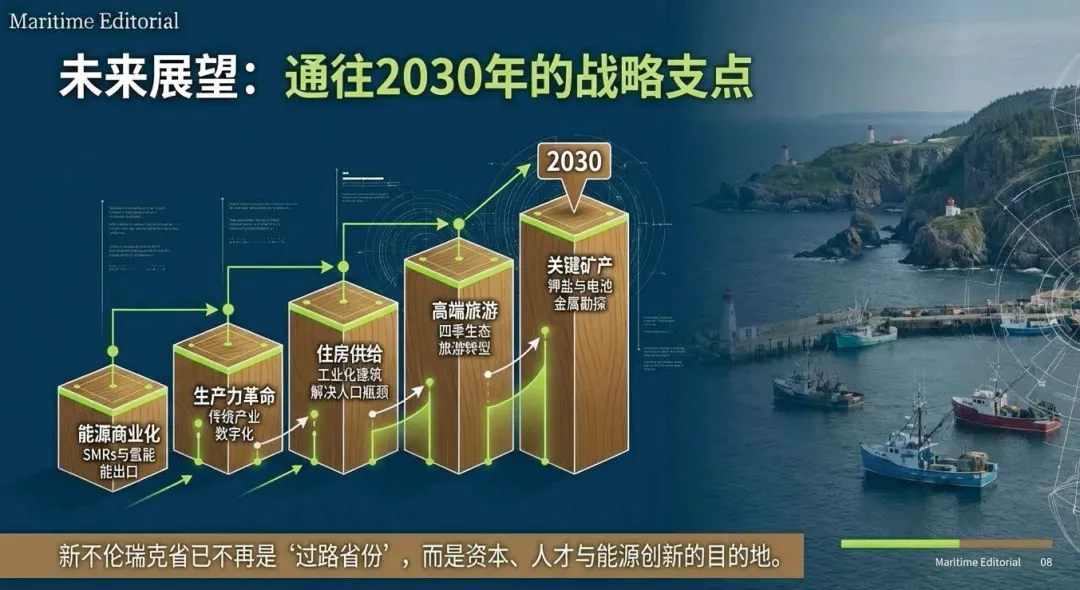
In the future, New Brunswick needs breakthroughs in the following areas:
- Promoting export diversification to reduce dependence on the U.S. market;
- Accelerating the energy transition and seizing the SMR nuclear opportunity;
- Solving livelihood issues such as housing and health care;
- Strengthening coordinated regional development and narrowing the urban–rural gap;
- Deepening economic cooperation with Indigenous peoples.
Only through sustained structural reform and innovative development can New Brunswick transform from a "peripheral province" into a "vibrant province".
Key Indicators
Total population (2024): 854,355 (+2.7% growth)
Median age: 44.8 years (trending younger)
Official language composition: English (~65%), French (~32%)
Expected real GDP growth (2025): ~1.0%–1.1%
Unemployment rate: about 7.3%–7.7%
Main exports: refined petroleum, lobster, wood, potato products
Provincial net debt forecast: 28.5% of GDP (2028–29)
Core enterprises: Irving Group, McCain Foods
Works Cited
New Brunswick | History, Cities, Facts, and Map | Britannica, accessed February 8, 2026, https://www.britannica.com/place/New-Brunswick-province
The top 10 attractions in New Brunswick | Destination Canada, accessed February 8, 2026, https://travel.destinationcanada.com/en-au/things-to-do/top-10-attractions-new-brunswick
Exploring Indigenous-led distributed energy systems in New Brunswick, accessed February 8, 2026, https://climateinstitute.ca/publications/exploring-indigenous-led-distributed-energy-systems-in-new-brunswick/
New Brunswick | Geography and Cartography | Research Starters, accessed February 8, 2026, https://www.ebsco.com/research-starters/geography-and-cartography/new-brunswick
How the changing face of the New Brunswick winter is forcing some people to face winter, accessed February 8, 2026, https://www.cbc.ca/news/canada/new-brunswick/winter-events-activities-nb-1.6753488
About New Brunswick: Atlantic Canada | Canadavisa.com, accessed February 8, 2026, https://www.canadavisa.com/about-new-brunswick.html
History of New Brunswick - Wikipedia, accessed February 8, 2026, https://en.wikipedia.org/wiki/History_of_New_Brunswick
New Brunswick: Unpacking Its Rich Meaning And Identity - Rockfeller, accessed February 8, 2026, https://experience.rockfeller.com.br/key-speak/new-brunswick-unpacking-its-rich-meaning-and-identity-1764807341
History and Culture - Government of New Brunswick, accessed February 8, 2026, https://www2.gnb.ca/content/gnb/en/corporate/promo/immigration/why-choose-nb/history-and-culture.html
Growing Miramichi: Population Growth Action Plan, accessed February 8, 2026, https://greatermiramichisc.ca/wp-content/uploads/2025/05/Growing-Miramichi-Population-Growth-Action-Plan-2025-28_FIN_October.pdf
New Brunswick - Wikipedia, accessed February 8, 2026, https://en.wikipedia.org/wiki/New_Brunswick
History of the Acadians - Wikipedia, accessed February 8, 2026, https://en.wikipedia.org/wiki/History_of_the_Acadians
New Brunswick | The Canadian Encyclopedia, accessed February 8, 2026, https://thecanadianencyclopedia.ca/en/timeline/new-brunswick
Population Report - NBjobs.ca, accessed February 8, 2026, https://www.nbjobs.ca/sites/default/files/2025-03/2025-02-19-LMI-Population-Report-EN.pdf
Report of the 2021 Review of the Official languages Act of New Brunswick, accessed February 8, 2026, https://www2.gnb.ca/content/dam/gnb/Departments/iga-aig/pdf/2021-review-official-languages.pdf
School Systems - The Canadian Encyclopedia, accessed February 8, 2026, https://www.thecanadianencyclopedia.ca/en/article/school-systems
THE GOVERNMENT OF NEW BRUNSWICK, accessed February 8, 2026, https://journals.lib.unb.ca/index.php/unblj/article/download/29785/1882524966/1882525426
The Acadian music explosion - CBC, accessed February 8, 2026, https://www.cbc.ca/music/the-acadian-music-explosion-1.6553620
New Brunswick, Irving company province - The Maine Monitor, accessed February 8, 2026, https://themainemonitor.org/new-brunswick-irving-company-province/
Our History - McCain Foods, accessed February 8, 2026, https://www.mccain.com/about-us/our-history/
About Us - McCain USA, accessed February 8, 2026, https://mccainfoodsusa.com/about-us/
Journal of Rural and Community Development, accessed February 8, 2026, http://susanodo.ca/wp-content/uploads/2020/03/2019-JRCD.pdf
Investigating Irving's New Brunswick Impact | PDF | Taxes - Scribd, accessed February 8, 2026, https://www.scribd.com/document/962984188/Investigating-Irving-s-New-Brunswick-Impact
Exploring The Irving Empire: A Deep Dive Into New Brunswick's Powerhouse, accessed February 8, 2026, https://testelecom.jis.az/blog/exploring-the-irving-empire-a-deep-dive-into-new-brunswicks-powerhouse-1767647457
Clean Energy - Government of New Brunswick, accessed February 8, 2026, https://www2.gnb.ca/content/gnb/en/corporate/promo/clean-energy.html
Small Modular Reactor - OPG, accessed February 8, 2026, https://www.opg.com/wp-content/uploads/2021/04/Provincial-FS-AODA_APRIL_2021_FINALv2.pdf
Neweg Energy Project - Natural Forces, accessed February 8, 2026, https://www.naturalforces.ca/projects/neweg-energy-project/
Ottawa announces funding for Indigenous-led wind projects, accessed February 8, 2026, https://www.ctvnews.ca/atlantic/article/ottawa-announces-funding-for-indigenous-led-wind-projects/
An In-Depth Look at the Canadian Institute for Cybersecurity - Opportunities NB, accessed February 8, 2026, https://onbcanada.ca/canadian-institute-for-cybersecurity-unb/
University of New Brunswick - Securing critical infrastructure through cyber innovation, accessed February 8, 2026, https://educationnewscanada.com/article/education/level/university/1/773116/securing-critical-infrastructure-through-cyber-innovation.html
N.B. votes 2024: Liberals win majority government, Holt province's first woman premier, accessed February 8, 2026, https://globalnews.ca/news/10815837/new-brunswick-election-2024-voting-day-oct-21/
New Brunswick Election 2024: History Made in the Maritimes, accessed February 8, 2026, https://strategycorp.com/2024/10/new-brunswick-election-2024-history-made-in-the-maritimes/
Economics and Statistics - Government of Nova Scotia, accessed February 8, 2026, https://novascotia.ca/finance/statistics/archive_news.asp?id=20845
First Nations in New Brunswick | The Canadian Encyclopedia, accessed February 8, 2026, https://www.thecanadianencyclopedia.ca/en/article/first-nations-in-new-brunswick
New Brunswick judges side with Irvings, other timber firms on Aboriginal title claim, accessed February 8, 2026, https://nbmediacoop.org/2025/12/13/new-brunswick-judges-side-with-irvings-other-timber-firms-on-aboriginal-title-claim/
News Room - North Shore Mi'kmaq Tribal Council, accessed February 8, 2026, https://nsmtc.ca/news/
Pre-budget consultation 2025-2026 - Government of New Brunswick, accessed February 8, 2026, https://www2.gnb.ca/content/dam/gnb/Corporate/pdf/consultations/2025-2026-pre-budget-consultation.pdf
Port of Saint John completes major container terminal expansion, accessed February 8, 2026, https://shippingmatters.ca/port-of-saint-john-completes-major-container-terminal-expansion/
Port Saint John completes West Side Modernization Project, accessed February 8, 2026, https://www.porttechnology.org/news/port-saint-john-completes-west-side-modernization-project-2/
Harvest (music festival) - Grokipedia, accessed February 8, 2026, https://grokipedia.com/page/harvest_music_festival
HOUSING ACTION STRATEGY - Town of Quispamsis, accessed February 8, 2026, https://www.quispamsis.ca/media/m5povnjs/quispamsis_housing-action-strategy-adopted-ver-date-2025-04-14.pdf
Contributions - World Pond Hockey Championship, accessed February 8, 2026, https://worldpondhockey.ca/contributions
Early cold snap a boost for World Pond Hockey Championship, accessed February 8, 2026, https://rivervalleysun.ca/early-cold-snap-a-boost-for-world-pond-hockey-championship/
Ganong Bros. - Wikipedia, accessed February 8, 2026, https://en.wikipedia.org/wiki/Ganong_Bros.
Canada's Chocolate Town | St. Stephen, New Brunswick, accessed February 8, 2026, https://town.ststephen.nb.ca/about/visiting-st-stephen/canadas-chocolate-town
Protecting the Chignecto Isthmus against climate change - Canada.ca, accessed February 8, 2026, https://www.canada.ca/en/housing-infrastructure-communities/news/2025/03/protecting-the-chignecto-isthmus-against-climate-change.html
Fundy tides to peak in 2034, adding urgency to Chignecto flood project, accessed February 8, 2026, https://www.cbc.ca/news/canada/new-brunswick/fundy-tides-higher-isthmus-fix-9.6938117
New Brunswick Office Marketbeat Q3 2025 - Cushman and Wakefield, accessed February 8, 2026, https://assets.cushmanwakefield.com/-/media/cw/marketbeat-pdfs/2025/q3/canada/nb_americas_marketbeat_office_q3-2025.pdf
New Brunswick Economic and Commercial Profile, accessed February 8, 2026, https://www.ice.it/it/sites/default/files/inline-files/NEW%20BRUNSWICK%202025.pdf
New Brunswick Economic Trends, Stats and Rankings - IBISWorld, accessed February 8, 2026, https://www.ibisworld.com/canada/economic-profiles/new-brunswick/
About New Brunswick - gnb.ca, accessed February 8, 2026, https://www.gnb.ca/en/admin/about-nb.html
Federal election 2025 report, WNNB, accessed February 8, 2026, https://wnnb.wolastoqey.ca/wp-content/uploads/federal_election_2025_report_wnnb.pdf
This article was originally published on the WeChat public account 「新不伦瑞克」 (New Brunswick Today); original link: mp.weixin.qq.com/s?__biz=MzI4Mjc3NDcyMg==&mid=2247484254&idx=1&sn=7a329cb990e4660881ad316dedc48db5&chksm=eb959ef3dce217e5a67d19f2f1d954c95f04149a9aa2140f0e68e55c5f07d3344c81167b8359&scene=178&cur_album_id=4378684396283723780&search_click_id=