
November 5, 2026
An In-Depth Investigative Report on Missing Persons and Criminal Justice Effectiveness in New Brunswick (2022–2026): An Analysis Based on Case Facts from the Major Cities
In 2022, missing-persons reports in New Brunswick rebounded past pre-pandemic levels: 1,722 cases, two-thirds of them minors. This report examines the province's three major cities — Saint John, Moncton and Fredericton — and the legislation, forensic technology and court backlogs shaping how long-term missing-persons cases are investigated and resolved.
Condensed Version
If you don't have time to read the full text, this condensed version covers it.
Missing-persons trends are closely tied to social vulnerability. 2022 was a watershed year for missing-persons data in the province, with reports rebounding sharply after the pandemic. The internal structure of the data shows clear differences between groups: disappearances of minors (especially girls) are mostly runaways, and are linked to potential human-trafficking networks; adult men face the highest risk of disappearing for "unknown cause." The growth in missing-persons reports is strongly associated with social problems such as the surge in homelessness and drug addiction (e.g. fentanyl abuse). In Moncton, a large share of missing-persons cases are essentially "social disappearances" — victims who have fallen under drug control or into street life.
The three major cities show distinct case profiles. Saint John faces the challenge of tightening police resources, and its cases centre on search blind spots in long-term files (the Kyle Richard LeBlanc case exposed the limits of manual searching in dense forest) and on intimate partner violence escalating to homicide. Moncton, the fastest-growing population centre, is deeply affected by the drug supply chain and the homelessness crisis; some streets have become "semi-blind spots" for law-enforcement monitoring, and landmark cases such as the murder of Melissa Price have occurred there. Fredericton's missing-persons cases show a strong "criminalization tendency": several long-term files are suspected to involve violent crime, and police increasingly rely on digital evidence such as cellphone data extraction and geolocation.
High technology is the key to cracking long-term cases. Solving long-term files depends heavily on breakthroughs in forensic science and technology. Whether it is using a forensic odontologist in Saint John to confirm the identity of remains, or using a drone equipped with ground-penetrating radar (GPR) in the Bathurst case to pin down a priority area of suspicion, high-tech evidence gathering is setting a new investigative standard for "no-body" cases and cases with extremely complex scene conditions.
New legal powers coexist with a crisis of efficiency in the justice system. The Missing Persons Act, enacted in 2022, gave police the power to obtain a missing person's communications and private data in non-criminal circumstances, greatly improving early investigative efficiency. But administrative bottlenecks in the justice system are offsetting those gains. Affected by the Supreme Court's Jordan decision, a shortage of court resources has caused the rate of stayed cases running past the deadline to soar, seriously threatening the ability to pursue criminal cases afterward.
There is a serious policy vacuum in protecting Indigenous people. The Auditor General's 2025 audit of the action plan on Missing and Murdered Indigenous Women and Girls (MMIWG) shows regulatory failure and an administrative vacuum on this issue in the province. The vast majority of commitments have made no progress, and the official database has serious gaps in geographic coverage, making it impossible to provide accurate province-wide statistics — a major policy gap.
Full text below.
In the public-safety landscape of New Brunswick (NB), 2022 to 2026 was a period of major turning points. This period not only saw missing-persons reports rebound from their low during the COVID-19 pandemic to historic highs, it also marked the province's entry into a period of intensive output in legislation, high-tech investigation and the judicial handling of long-term cases. This report focuses on the three major cities — Moncton, Saint John and Fredericton — and, by unpacking the 2022 baseline data and what followed, attempts to reconstruct a fact- and data-based picture of missing-persons safety.
Chapter 1: Province-Wide Missing-Persons Statistics and the 2022 Turning Point
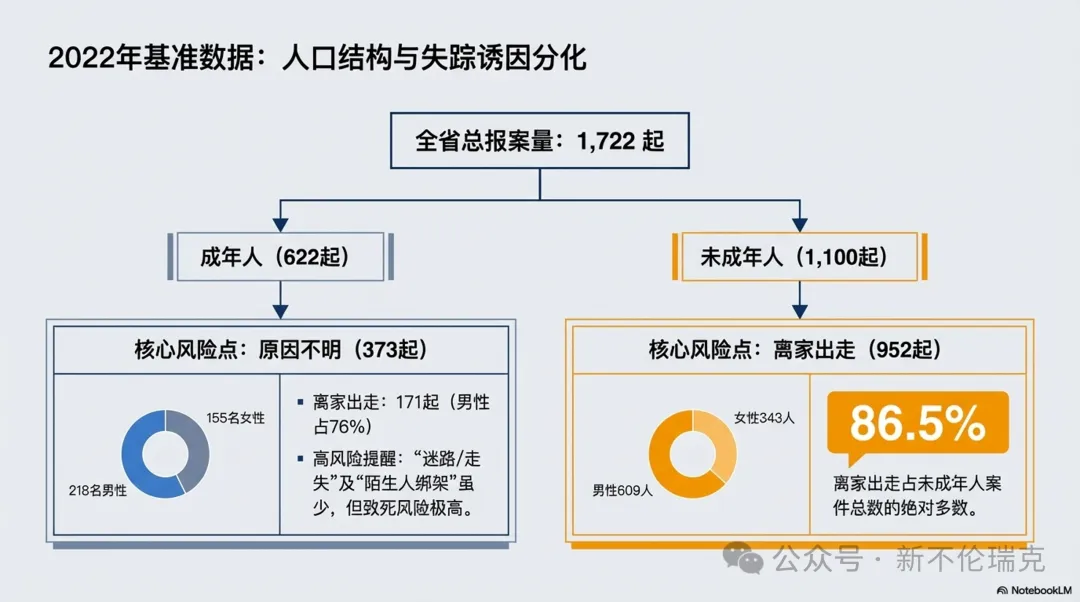
2022 was a watershed year for missing-persons data in New Brunswick. As social mobility fully recovered, province-wide missing-persons reports rose by about 16% over 2021, gradually returning to and exceeding the pre-2019 normal level [1]. According to the National Centre for Missing Persons and Unidentified Remains (NCMPUR), the province recorded 1,722 missing-persons incidents in 2022, of which 622 involved adults and 1,100 involved minors [1].
1.1 2022 Province-Wide Statistics by Category
The 2022 statistics reveal striking differences in what drives disappearances among different groups. Cross-analysis by sex and motive shows that adult men have the highest proportion of "unknown cause" disappearances, while "runaway" accounts for the overwhelming majority of minors' disappearances.
Category: Adults
| Probable Cause | Female | Male | Total |
|---|---|---|---|
| Runaway / unexcused absence | 41 | 130 | 171 |
| Unknown cause | 155 | 218 | 373 |
| Lost / wandering (cognitive impairment, etc.) | 8 | 33 | 41 |
| Stranger abduction | 4 | 1 | 5 |
| Accident | 0 | 1 | 1 |
| Custodial / family abduction | 2 | 0 | 2 |
| Other causes | 15 | 14 | 29 |
Adult subtotal: 225 females, 397 males, 622 in total.
Category: Minors
| Probable Cause | Female | Male | Total |
|---|---|---|---|
| Runaway (86.5%) | 343 | 609 | 952 |
| Unknown cause | 49 | 76 | 125 |
| Stranger abduction | 1 | 2 | 3 |
| Lost / wandering | 2 | 5 | 7 |
| Custodial / family abduction | 4 | 5 | 9 |
| Other causes | 2 | 2 | 4 |
Minor subtotal: 401 females, 699 males, 1,100 in total.
2022 annual total: 626 females, 1,096 males, 1,722 in total.
1.2 How the Data Evolved, 2023–2024
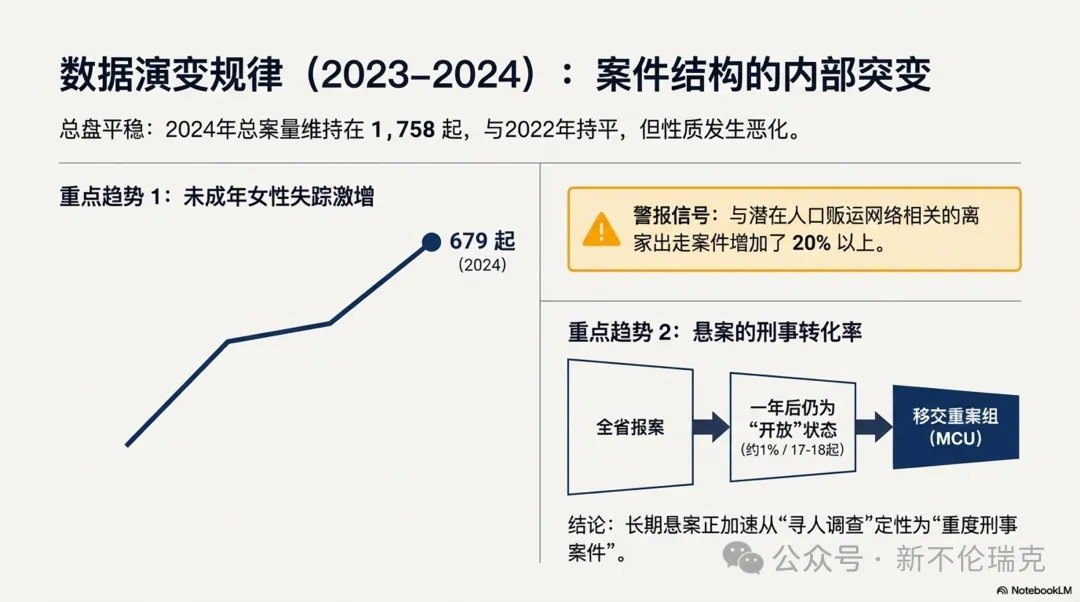
Going into 2024, the province-wide total of missing-persons cases held at around 1,758, roughly the same as in 2022, but the internal structure of the caseload changed profoundly. One striking feature was a sharp rise in 2024 in the proportion of missing minor females (679 cases), with runaway cases linked to potential human-trafficking networks up by more than 20% [2]. In addition, 2024 statistics show that about 1% of the province's missing-persons cases were still "open" one year after being reported (about 17–18 cases), and these cases typically then become criminal investigations under the Major Crime Unit (MCU) [2].
Chapter 2: Saint John — The Lakewood Heights Case and Intimate Partner Violence
Saint John, the province's oldest industrial city, saw its missing-persons cases prompt province-wide reflection on the investigation of long-term files in 2022, after a high-profile discovery of human remains.
2.1 The Full Record of the 2022 Discovery of Kyle Richard LeBlanc's Remains
The disappearance and discovery of Kyle Richard LeBlanc is one of the most consequential inconclusive cases in Saint John in recent years. What began as a routine missing-persons investigation became a two-year search, finally resolved with unexpected help from a member of the public — a process full of technical detail and procedural considerations.

Kyle Richard LeBlanc
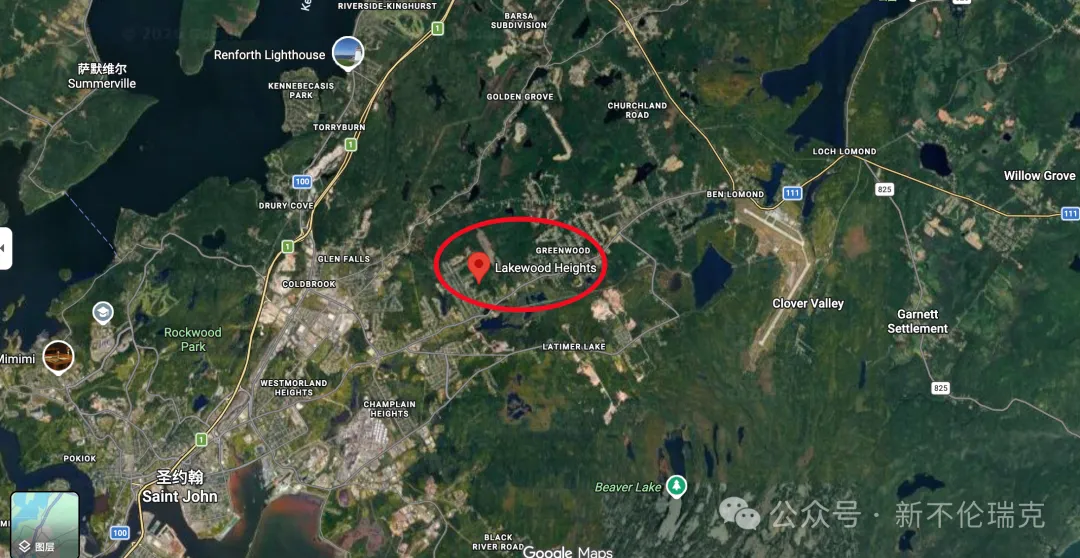
Background on the victim: Kyle Richard LeBlanc was only 32 years old when he went missing. He was described as 6 feet tall (about 183 cm), 170 pounds (about 77 kg), with green eyes and hair dyed a golden-red colour [4]. He was last seen at about 4:20 p.m. on December 30, 2020, near Loch Lomond Road in Saint John's east side. At the time he was wearing a light grey jacket and black athletic pants [5].
The fruitless searches of 2021:
After the report was received at the end of 2020, the Saint John Police Force (SJPF) and Ground Search and Rescue (GSAR) carried out three large-scale systematic searches in the spring of 2021.
- Phase 1 (March 2021): the forest and marshland north of Lakewood Heights.
- Phase 2 (April 2021): expanded to the northeastern Lakewood Heights area.
- Phase 3 (May 2021): drones and police dogs covering the west side of Golden Grove Road. Despite the use of infrared thermal imaging and multiple volunteer teams, none of these searches produced any physical evidence [7].
Factual timeline of the 2022 discovery:
Lakewood Heights
- Friday, August 12, around 6:00 p.m.: a hiker near Lakewood Heights, off the main trail in dense forest, discovered what appeared to be human skeletal remains [5].
- Saturday, August 13: Saint John police sealed off the scene, and Forensic Identification Services attended.
- Sunday, August 14: police expanded the search radius to 1.8 acres and found more skeletal remains about 100 metres from the first set [4].
- Monday, August 15: police invited a forensic odontologist to assist.
- Tuesday, August 16: police formally announced that comparison of dental records had confirmed the remains as those of Kyle Richard LeBlanc [5].
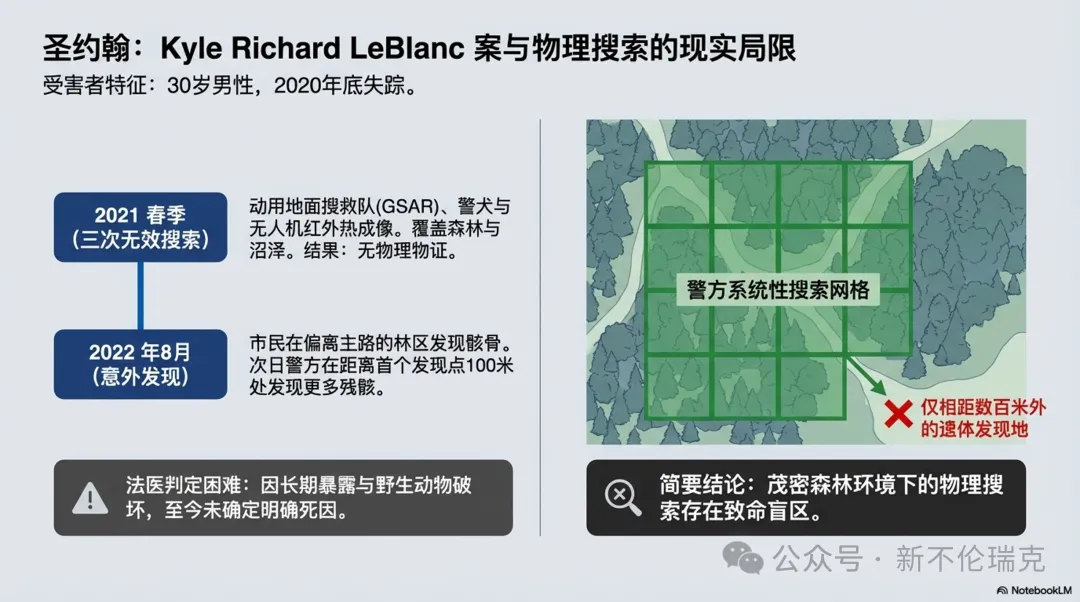
What followed, and what remains unresolved: As of the end of 2023, the Saint John Police Force's Major Crime Unit still listed the case as a "death investigation" rather than a confirmed homicide. A forensic anthropologist's preliminary report noted that, because the bones had been exposed to the natural environment for a long time and gnawed by wild animals, it was difficult to determine a fatal injury directly at the scene [6]. The key fact of this case is that the body was found only a few hundred metres from routes police had searched repeatedly — exposing the blind spots of manual searching in extremely dense forest.
2.2 Intimate Partner Violence (IPV) Homicides in Saint John
The Saint John Police Force's 2022 annual report shows that a considerable share of the city's policing resources was consumed by domestic disputes [10]. From 2024 to 2026, this trend escalated into lethal violence.
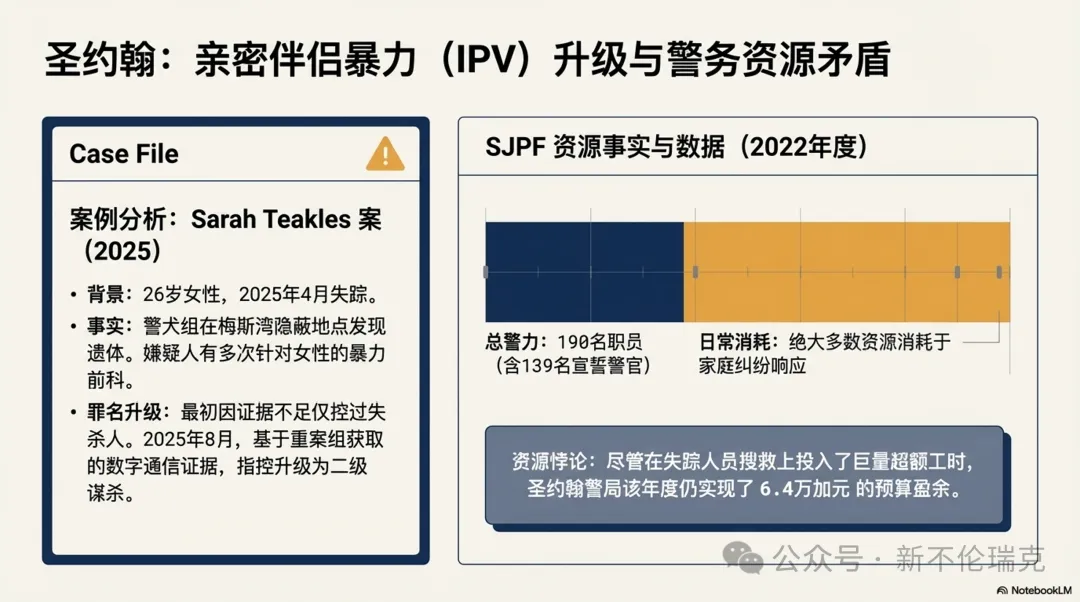
Case: Sarah Teakles (April 2025)
Sarah Teakles, a 26-year-old Saint John resident, was reported missing on April 14, 2025. The facts proved this to be a classic case of intimate partner violence escalating to homicide.
Discovery of evidence: Saint John police, working with the canine unit, found Teakles' body at a secluded location in Maces Bay [2].
Criminal facts: The suspect, Calvin Burns-Smith, had multiple prior records of violence against women.
Change in the charges: Prosecutors initially laid only a manslaughter charge for lack of evidence, but in August 2025, on the basis of digital communications evidence obtained by the Major Crime Unit, the charge was formally upgraded to second-degree murder [2].
2.3 Saint John Policing Resources: The Facts
In 2022, the Saint John Police Force had 190 staff, including 139 sworn officers. That year the department handled 15 complaints under the Police Act. Its financial report shows that, despite spending excess overtime on missing-persons searches, the year still ended with a budget surplus of C$64,000 — a sign of the extreme austerity in its allocation of resources [10].
Chapter 3: Moncton — Human Trafficking and the Homelessness Crisis in the Codiac Region
Moncton, the province's fastest-growing population centre, has missing-persons cases closely tied to the drug supply chain, the surge in homelessness, and the Halifax–Quebec organized-crime corridor.
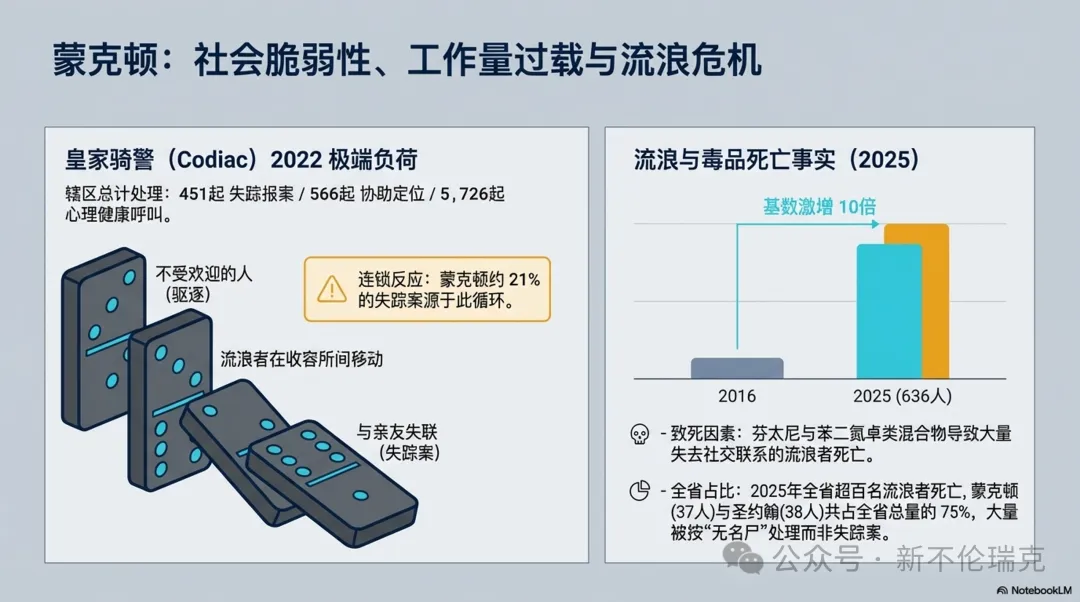
3.1 Codiac Regional RCMP Workload in 2022
Policing statistics for Moncton and its surrounding area (Dieppe and Riverview) directly reflect the effect of social disorder on missing-persons cases. In 2022, calls to the Codiac Regional RCMP for "assistance locating a missing person" reached their highest level ever.
| Area (2022) | Missing-Persons Reports | Assistance Locating | Mental-Health Intervention Calls |
|---|---|---|---|
| Moncton | 377 | 470 | 4,200+ |
| Dieppe | 59 | 58 | 800+ |
| Riverview | 15 | 38 | 300+ |
| Total | 451 | 566 | 5,726 |
Source: [11].
The facts show that about 21% of Moncton's missing-persons cases were follow-up reports triggered by "unwanted person" classifications — typically involving people experiencing homelessness whose movement between shelters caused family and friends to lose contact [11].
3.2 Breaking Down the Facts of the 2026 Melissa Price Murder
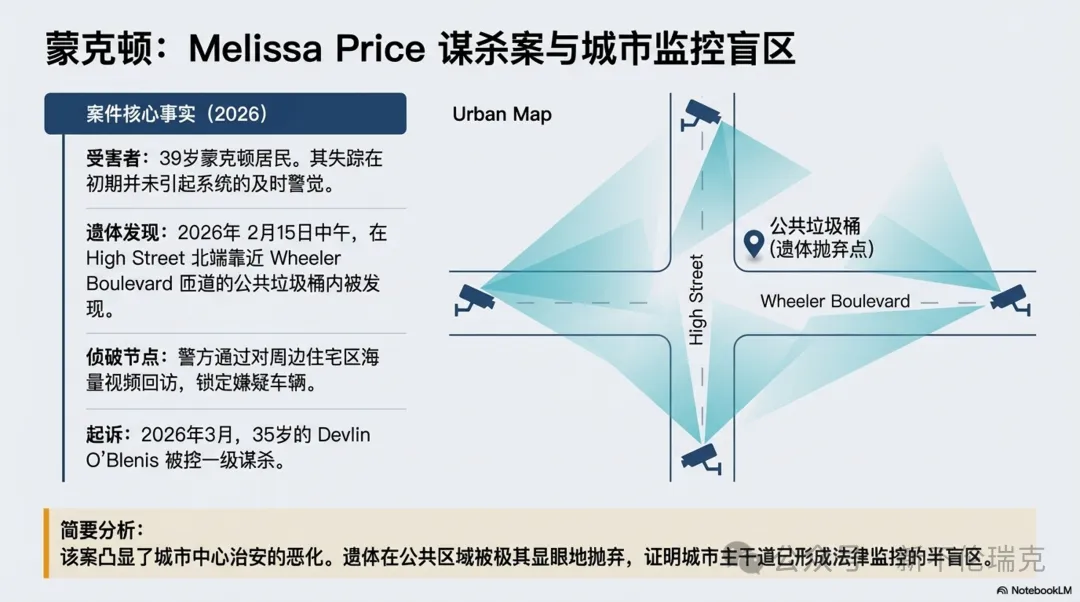
The Melissa Price case is a landmark event in the deterioration of public safety in Moncton's downtown core.
The incident: At 12:10 p.m. on February 15, 2026, Moncton RCMP received a report of a woman's body found in a garbage bin at the north end of High Street, near the Wheeler Boulevard ramp [1].
The victim: Melissa Price, a 39-year-old Moncton resident.
How it was solved: Police reviewed extensive video footage from the Norwood Avenue residential area and identified a suspect vehicle.
The charges: On March 11, 2026, 35-year-old Devlin O'Blenis was arrested and charged with first-degree murder [2]. The factual significance of this case is that Price's disappearance did not raise timely alarm — it was only when her body was discarded in a highly visible public place that it was found — showing that certain Moncton streets (such as High Street) have become "semi-blind spots" for law-enforcement monitoring.
3.3 Homelessness and Drug Deaths in Moncton: The Facts
Statistics for 2025 show that Moncton's homeless population has grown tenfold from its 2016 base, reaching 636 people. Among these groups, the province recorded more than 100 deaths of people experiencing homelessness in 2025, of which Moncton (37) and Saint John (38) accounted for 75% of the province-wide total [1]. Although many of these deaths were not listed as missing-persons cases, the drug abuse behind them (especially mixtures of fentanyl and benzodiazepines) caused large numbers of people experiencing homelessness to die quickly after losing social contact, and to be processed as "unidentified bodies" [2].

"The fentanyl fold": after taking fentanyl, the body loses control and takes on a strange posture.
Chapter 4: Fredericton — Cold Cases, Rewards and a High-Risk Profile
Fredericton's missing-persons profile shows a strong "criminalization tendency." Unlike Moncton, where youth runaways are common, several of Fredericton's landmark cases involve disappearances unresolved for years, and police have explicitly suspected "foul play."
4.1 Fact Table of Fredericton's Landmark Cold Cases
| Name | Date Missing | Facts | Investigation Status |
|---|---|---|---|
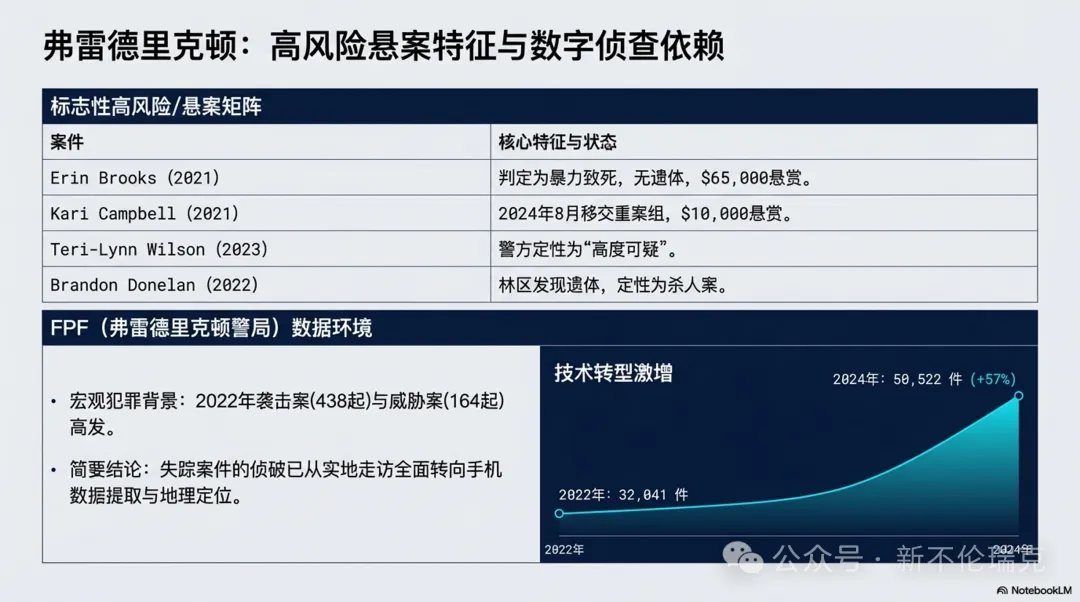
| Erin Brooks | December 27, 2021 | 38 years old, last seen in Fredericton's north side. Slim build, brown hair [15]. | Reward of C$65,000. Police have determined it was a violent death; the body has not been recovered [15]. |
| Kari Lynn Rose Campbell | August 2021 | 38 years old. Last sighting location unknown. | Formally transferred to the Major Crime Unit (MCU) on August 19, 2024. Family reward of C$10,000 [16]. |
| Teri-Lynn Wilson | April 13, 2023 | 41 years old, white, 5'4", 110 lbs. Last spoke with family [15]. | Police issued a renewed appeal in October 2023, characterizing the case as highly suspicious. |
| Brandon Donelan | January 2022 | After being reported missing, his body was found on March 31, 2022 in the Minto woods by a snowmobiler [17]. | Determined to be a homicide. |
4.2 Fredericton Police Force (FPF) Operating Data
Fredericton police handle an average of about 100 formal missing-persons files per year [18].
2022 statistics: Among Fredericton's top five crime categories in 2022, assault (438 cases) and uttering threats (164 cases) ranked first, providing the macro crime background for the criminal characterization of missing-persons cases [19].
Technical capacity: In 2024, the volume of digital evidence handled by Fredericton police surged from 32,041 items in 2022 to 50,522 items — an increase of 57% — showing that missing-persons investigations increasingly depend on cellphone data extraction and geolocation analysis [20].
Chapter 5: Special Focus — In-Depth Analysis of High-Impact and Unresolved Cases
Beyond the core city cases above, the period 2022–2026 saw several cross-regional cases in New Brunswick with major technical or social impact.
5.1 The Technical Evidence in the Bathurst Case of Madison Roy-Boudreau
Fourteen-year-old Madison Roy-Boudreau went missing in May 2021, and her case saw the most intensive technical evidence gathering between 2022 and 2025.
Last sighting: Roy-Boudreau was seen getting into a grey Ford pickup truck belonging to 45-year-old Steven Laurette [2].
Ground-penetrating radar (GPR): In September 2025, the RCMP used a drone equipped with GPR in the Middle River area southwest of Bathurst. The equipment did in fact detect several areas of disturbed soil, and although the ground excavation in October 2024 did not directly find a body, it pinned down a 1.8-acre priority area of suspicion [2].
The suspect's record: Laurette is currently serving a sentence for sexually assaulting another 14-year-old girl. Although police have not found Madison's body, based on long hairs and blood-stain swabs (red stains) collected from the vehicle, the case has been classified as a first-degree murder investigation [4].
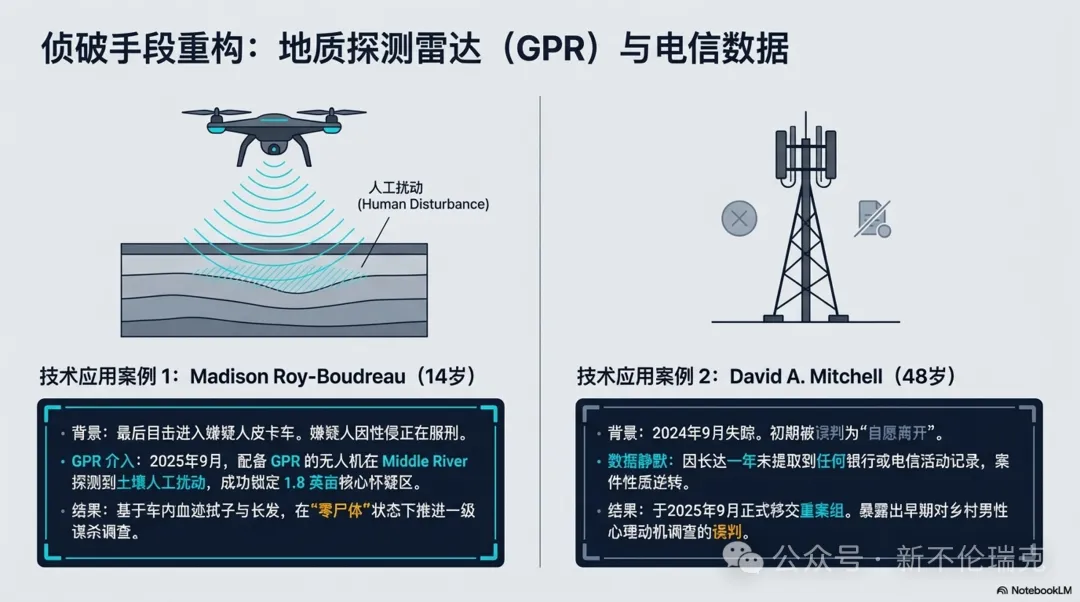
5.2 The Case of David Alexander Mitchell
Disappearance: On September 9, 2024, 48-year-old Mitchell went missing on Whites Mountain [16].
Characterization: Initially treated as a "voluntary departure," the case was formally transferred to the Major Crime Unit (MCU) in September 2025, after a year in which no bank or telecommunications activity could be traced.
Current status: As a typical "unknown cause" case, it exposes how early investigations in rural areas misjudged the psychological motives of adult men [2].
Chapter 6: The Legal, Institutional and Policy Framework — The Facts
Searching for missing persons and securing convictions depends not only on field investigation, but also on the dramatic changes in the province's legal environment after 2022.
6.1 The 2022 Missing Persons Act: Key Facts
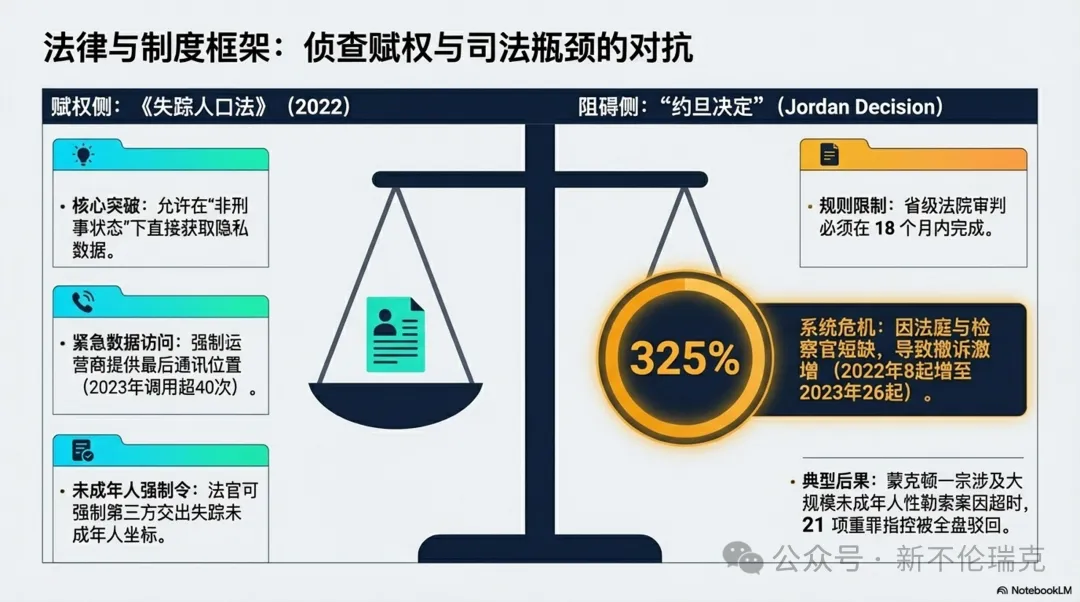
The Act was passed on December 16, 2022 (CHAPTER 2022, c.45), and its core is to give police the power to access private data in "non-criminal circumstances" [21].
Key provisions of the Act:
- Urgent demands for records (ss. 6–8): A police officer may issue an urgent demand to a third party (such as a carrier) requiring it to provide a missing person's last communications location, without first obtaining a warrant from a judge. In 2023, this provision was invoked more than 40 times.
- Records access orders (s. 2): In non-urgent cases, police may apply to the provincial court to obtain a missing person's financial and health records.
- Sealing orders (s. 16): To prevent interference with an investigation, a judge may order that records relating to a search warrant be sealed from the public.
- Compulsory provisions for minors (s. 3): If the missing person is a minor and is known to be with a particular third party, a judge may compel that third party to hand over the minor's specific coordinates [21].
6.2 The Judicial Crisis Caused by the Jordan Decision
Under the Supreme Court's 2016 Jordan ruling, trials in provincial court must be completed within 18 months. In New Brunswick, a shortage of courtroom space and prosecutors has left criminal cases connected to missing persons facing large-scale stays [1].
Surge in stays: Province-wide, criminal charges stayed because of delay rose from 8 in 2022 to 26 in 2023 (a 325% increase).
Cases affected: In 2024, two men in Moncton accused of large-scale sextortion of minors had all 21 serious criminal charges against them dismissed by the court, because the proceedings had exceeded 18 months [6].
Chapter 7: The Auditor General's Audit of the MMIWG Action Plan (2025)
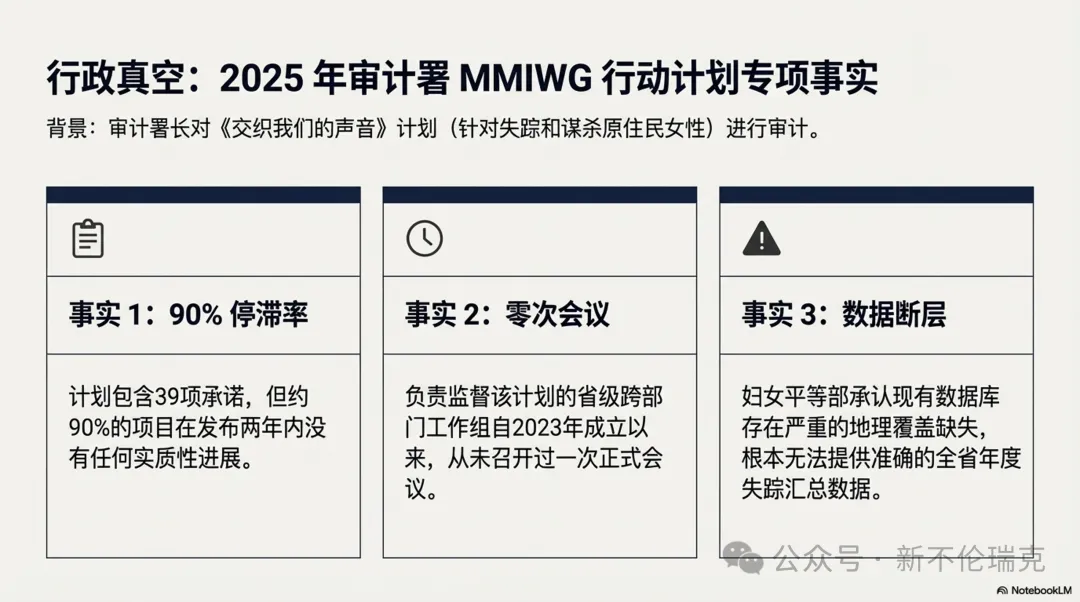
In December 2025, Auditor General Paul Martin released a special audit of the plan on Missing and Murdered Indigenous Women and Girls (MMIWG); the factual findings were highly contentious [2].
Administrative vacuum: The province's Weaving Our Voices Together plan contains 39 commitments, but the audit found that about 90% of the items had made no substantive progress in the two years since publication.
Regulatory failure: The provincial interdepartmental working group responsible for overseeing the plan has not held a single formal meeting since it was established in 2023.
Data gaps: The audit confirmed that the Women's Equality Branch, when asked about statistics on missing Indigenous women, acknowledged that its existing database has serious gaps in geographic coverage and cannot provide accurate province-wide annual totals [2].
Chapter 8: Conclusion — A Data-Driven Picture of Public Safety
Combining the 2022–2026 data for Moncton, Saint John and Fredericton, this investigation reaches the following fact-based conclusions.
First, the growth in missing-persons reports is strongly correlated with social vulnerability (homelessness and addiction). Of Moncton's 451 missing-persons reports in 2022, a considerable share were "social disappearances" — victims who frequently changed location because they had fallen under drug control or into street life [11].
Second, solving long-term cases still depends heavily on forensic breakthroughs. Although the Kyle Richard LeBlanc case was solved because a member of the public happened to find the remains, the dental comparison and the 1.8-acre grid search that followed set a standard for handling such scenes [5]. By contrast, cases such as Erin Brooks in Fredericton remain trapped in the evidentiary dilemma of a "no-body" investigation [15].
Finally, the administrative efficiency of the justice system has become the bottleneck in protecting missing-persons victims. A 400% increase in the stay rate in 2023 and a fiscal deficit of C$1.3 billion are now threatening the province's ability to pursue criminal cases on missing persons. In particular, the stalling of the action plan for Indigenous people shows a huge policy vacuum between data collection and on-the-ground protection [2].
Every data point and case cited in this report together sketch a picture of a New Brunswick public-safety landscape seeking balance between depleted resources and technological progress. 2026 will be the key year for testing whether the Missing Persons Act and new technologies such as GPR can translate into real clearance rates.
Works Cited
- Background — 2022 Fast Fact Sheet — Canada's Missing, canadasmissing.ca/pubs/2022/index-eng.htm
- 深度研究NB省失踪人口案件 (In-depth research on missing-persons cases in New Brunswick; no URL given in the original)
- 2024 Fast Fact Sheet — Canada's Missing, canadasmissing.ca/pubs/2024/index-eng.htm
- Police in N.B. say more human remains found in wooded area of Saint John — Global News, globalnews.ca/news/9060664/saint-john-more-human-remains-wooded-area
- Human remains identified as missing Saint John man: police — CTV News, ctvnews.ca/atlantic/article/human-remains-identified-as-missing-saint-john-man-police
- Human remains found in Saint John identified as man missing since 2020 | Globalnews.ca, globalnews.ca/news/9062863/human-remains-kyle-leblanc-missing
- Remains identified as missing Saint John man Kyle LeBlanc | CBC, cbc.ca/news/canada/new-brunswick/saint-john-kyle-leblanc-remains-identified-1.6552263
- Saint John Police Force 2022 Annual Report, saintjohnpolice.ca/wp-content/uploads/2023/04/2022-Annual-Report-PDF.pdf
- 2022, c.45 — Missing Persons Act — Acts and Regulations, laws.gnb.ca/en/document/cs/2022, c.45
- New Brunswick RCMP releases 2024 Annual Report | Royal Canadian Mounted Police, rcmp.ca/en/nb/news/2025/11/4347868
This article was originally published on the WeChat public account 「新不伦瑞克」 (New Brunswick Today); original link: mp.weixin.qq.com/s?__biz=MzI4Mjc3NDcyMg==&mid=2247485545&idx=1&sn=40b6543941907f3bdad2abf704d1da5a&chksm=eb9595c4dce21cd2c7f7a29c45a2ef9334c4e91914b324f5444c10134cb25ebe2633441d7ff9&scene=178&cur_album_id=4378684396283723780&search_click_id=