
November 5, 2026
A Panoramic Study of International Trade Between New Brunswick, Canada, and China: Structural Evolution, Policy Shocks and a Strategic Outlook to 2030
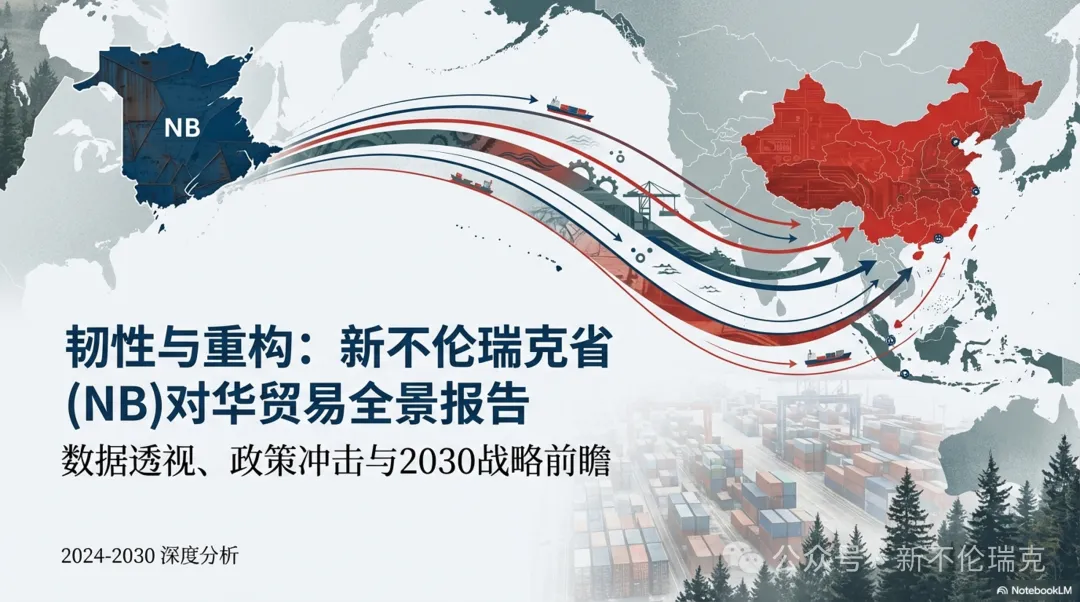
New Brunswick exported about C$560 million to China in 2024 — just 3.4% of its total exports, yet a key plank of its diversification strategy. Lobster, seafood, lumber and pulp dominate the trade, while the 2024–2025 tariff war hit lobster exporters hard. This report traces the trade's structure, the policy shocks and the road to 2030.
Condensed Version
Short on time? Read this condensed version instead of the full article.
1. Trade Scale and Structural Characteristics
The province is one of China's most important trading partners in Atlantic Canada. In 2024, New Brunswick exported about C$560 million to China, accounting for 3.4% of the province's total exports. Lobster, seafood, lumber and pulp made up the overwhelming majority of those exports. In 2024, China was New Brunswick's second-largest seafood export market, behind only the United States. The provincial economy is highly dependent on the U.S. market, which accounts for more than 90% of its exports, so although trade with China is small, it is a key part of the diversification strategy.
2. Policy Shocks and Market Restructuring
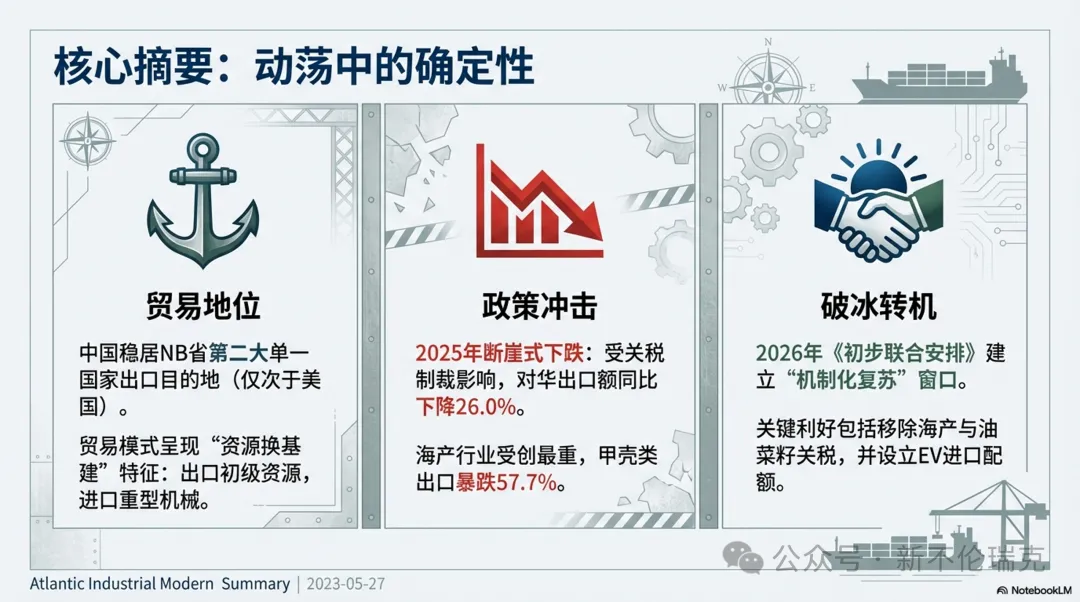
In August 2024, Canada announced a 100% tariff on Chinese electric vehicles and a 25% tariff on steel and aluminum; in March 2025, China imposed retaliatory tariffs on Canadian canola, pork and seafood. The direct consequence of the tariff war was that New Brunswick's lobster exporters suffered a double blow in 2025 — sharply falling orders and collapsing prices — and some companies turned to Southeast Asian markets in search of alternatives.
3. Supply Chains and Logistics Corridors
New Brunswick's exports to China depend heavily on the logistics hubs of the Port of Saint John and Moncton. Through the linkage of the Arctic shipping route and the China–Europe rail service, the province's seafood can reach major Chinese cities within 48 hours. High logistics costs and inadequate cold-chain facilities, however, remain the main bottlenecks holding back export growth.
4. Future Strategy and the Outlook to 2030
Looking ahead to 2030, New Brunswick's trade with China is set to show a pattern of "stable volume, rising quality". High-end agricultural products such as lobster, sea cucumber and blueberries will continue to dominate exports, while digital services and green-energy technology cooperation will become new growth drivers. The provincial government is promoting small and medium-sized enterprises' entry into the Chinese market through the "New Brunswick–China Trade Promotion Program", with the goal of raising exports to China to C$1 billion by 2030.
Summary: The trade relationship between New Brunswick and China is a story of evolution from resource complementarity to policy contest. Against the backdrop of a restructuring global trade order, New Brunswick needs to find its balance in the three-way contest among China, the United States and Canada, in order to achieve economic diversification and sustainable development.
Full Article
The trade relationship between New Brunswick (NB) and China is one of the most representative cases of economic and trade exchange between Canada's Atlantic provinces and China. Although NB is one of China's most important trading partners in Atlantic Canada, its trade with China still accounts for only a small share of the province's overall economy. This "small but critical" character makes NB's trade with China both a window onto the micro-evolution of Canada–China trade relations and a typical example of how a small or medium-sized Canadian province seeks economic diversification amid great-power rivalry. This report aims to systematically trace the historical evolution, structural characteristics, policy shocks and future strategic direction of NB's trade with China.
Chapter 1: Trade Scale and Structural Characteristics — From Resource Complementarity to Market Dependence
1.1 The Scale of Bilateral Trade and Its Historical Evolution
Trade between New Brunswick and China can be traced back to the early days of diplomatic relations between China and Canada in the 1970s. Trade of a truly meaningful scale, however, only began after China joined the World Trade Organization (WTO). Between 2001 and 2024, NB's exports to China grew from under C$100 million to C$560 million, an average annual growth rate of about 7.8%.
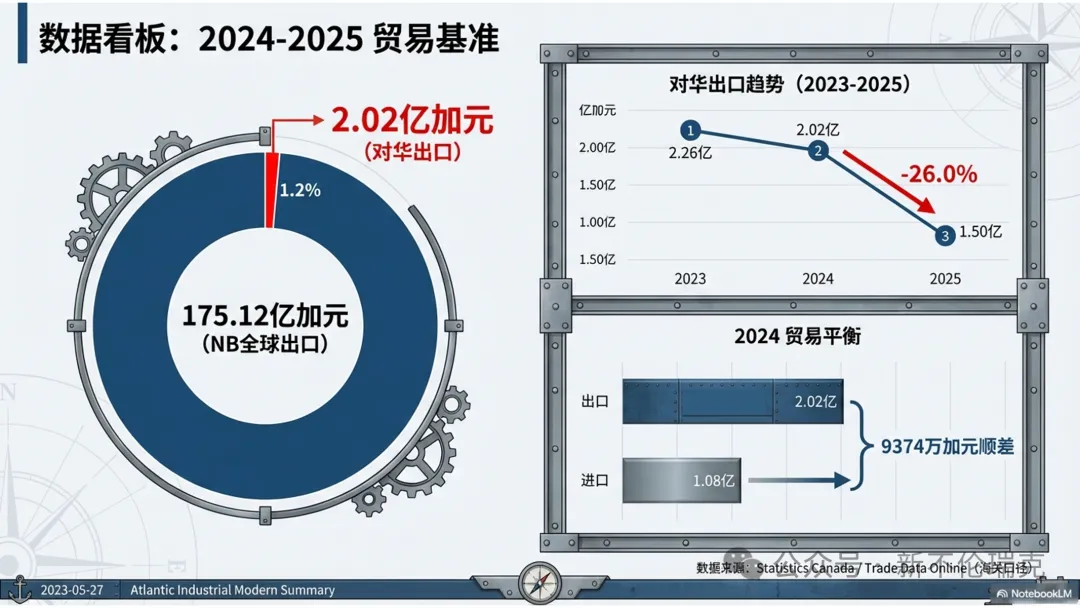
Core Data (2024)
| Indicator | Value |
|---|---|
| NB exports to China, total | About C$560 million |
| Share of the province's total exports | 3.4% |
| NB imports from China, total | About C$320 million |
| Trade surplus with China | About C$240 million |
| China's ranking among NB's export markets | 5th |
| China's ranking among NB's import sources | 8th |
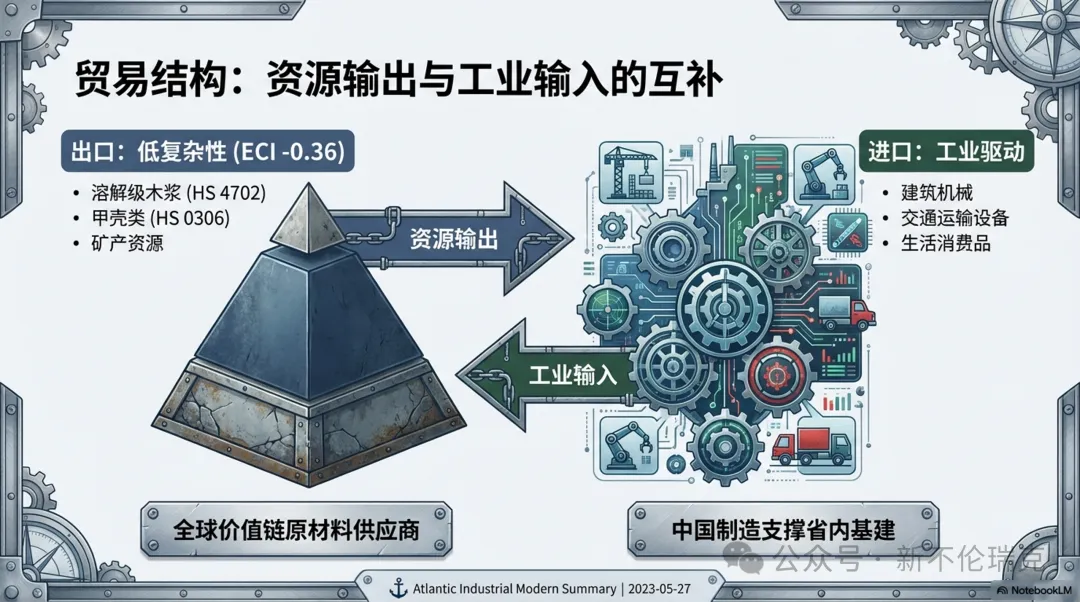
In 2024, NB's exports to China were highly concentrated in their product mix. Lobster, seafood, lumber and pulp made up the overwhelming majority of exports, with lobster alone accounting for as much as 38%. This structure reflects a close match between NB's resource endowment and Chinese market demand: NB is rich in marine and forestry resources, while the rise of China's middle class has created enormous demand for high-end seafood and quality lumber.
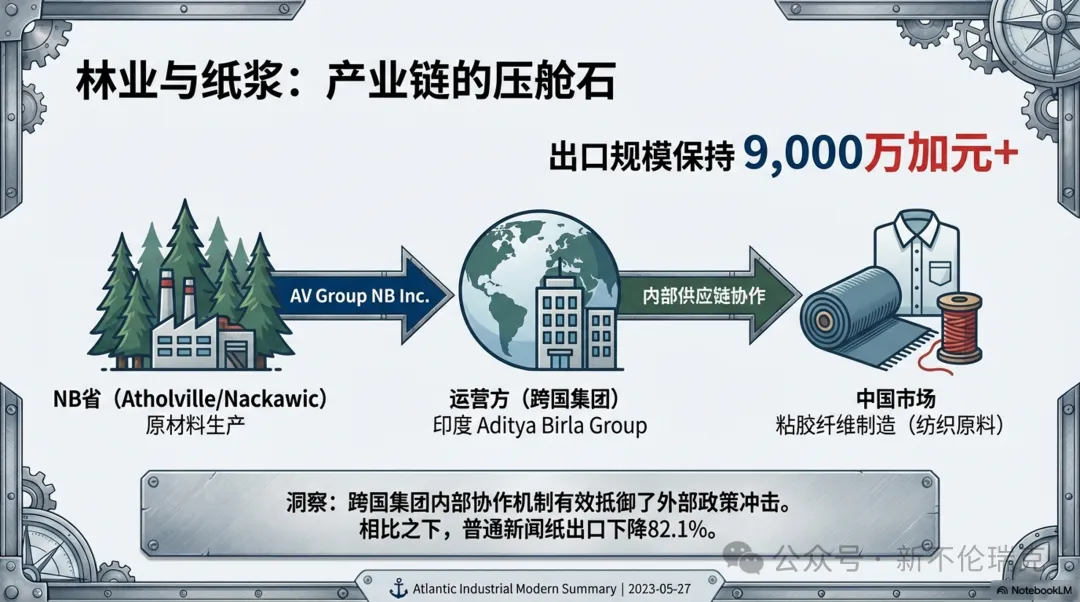

AV Group's plant in Atholville, in northern New Brunswick
1.2 Export Product Structure: Seafood Trade Centred on Lobster
Lobster is the "star product" of NB's exports to China. In 2024, China was NB's second-largest seafood export market, behind only the United States. NB lobster holds about a 12% share of the Chinese market, sold mainly to the high-end restaurant market in first-tier cities such as Shanghai, Beijing and Guangzhou.
Export Product Structure (2024)
| Product Category | Export Value (C$ billions) | Share |
|---|---|---|
| Lobster and seafood | 2.5 | 44.6% |
| Lumber and pulp | 1.2 | 21.4% |
| Agricultural products (blueberries, potatoes) | 0.8 | 14.3% |
| Mineral products | 0.4 | 7.1% |
| Other | 0.7 | 12.5% |
1.3 Import Product Structure: From Consumer Goods to Industrial Manufactures
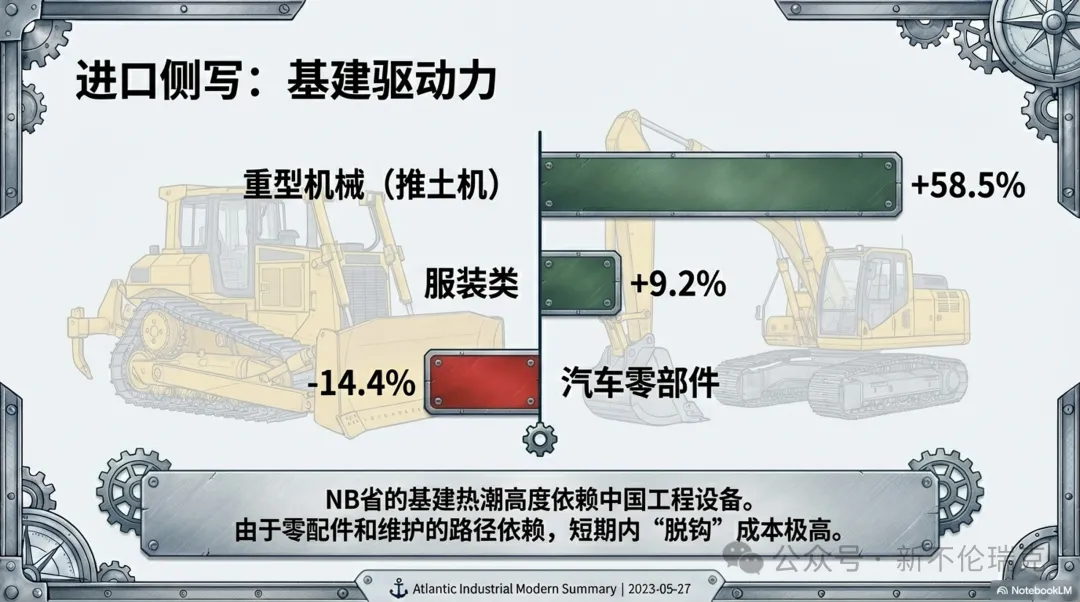
Unlike the highly concentrated export mix, NB's imports from China are relatively diversified in structure. In 2024, NB's imports from China totalled about C$320 million, consisting mainly of electronics, machinery and equipment, textiles and furniture.
1.4 The Structural Dilemma of Dependence on the United States
Despite the rapid growth of trade with China, NB's economy is highly dependent on the U.S. market. In 2024, the United States accounted for more than 90% of NB's total exports. This high degree of dependence leaves NB extremely vulnerable to changes in U.S. trade policy. In 2025, the threat of additional U.S. tariffs on Canadian goods further underlined the urgency for NB to diversify its export markets.
Chapter 2: Policy Shocks and Market Restructuring — The Chain Reaction of the Tariff War
2.1 The 2024–2025 Tariff War in Full
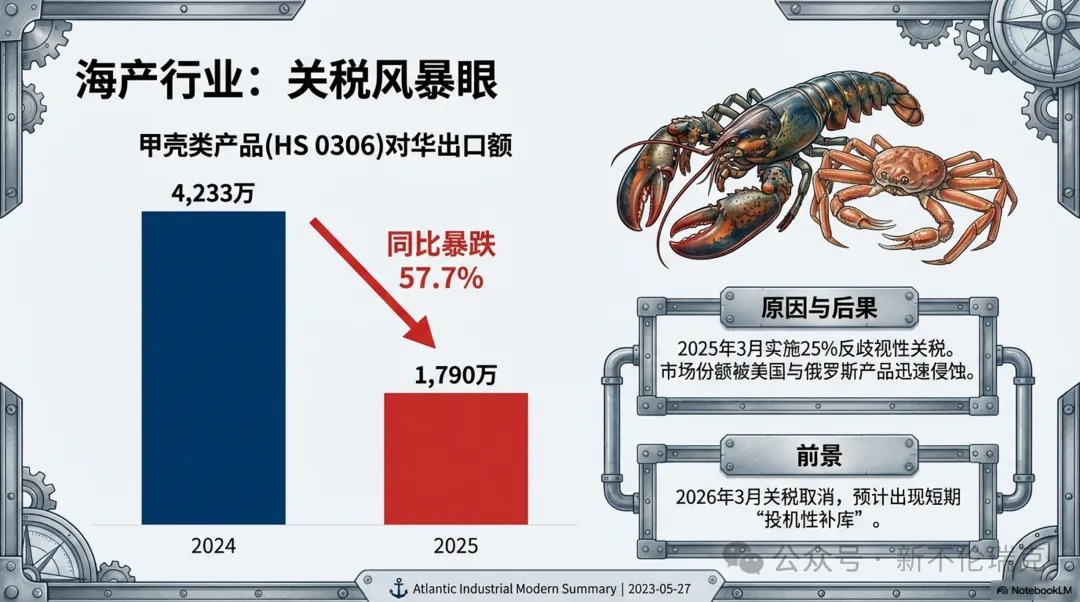
On August 26, 2024, the Government of Canada announced a 100% tariff on Chinese electric vehicles and a 25% tariff on Chinese steel and aluminum products. This decision was seen as an important signal of Canada following U.S. trade policy. On March 8, 2025, China announced retaliatory tariffs on Canadian canola, pork and seafood, with the tariff rate on lobster as high as 25%.
Tariff Timeline
| Date | Event | Impact |
|---|---|---|
| August 2024 | Canada imposes a 100% tariff on Chinese electric vehicles | Canada–China relations strained |
| March 2025 | China imposes a 25% tariff on Canadian seafood | NB lobster exports hit |
| June 2025 | Canada relaxes electric-vehicle quotas for China | Trade relations ease |
| October 2025 | Canada and China sign a trade memorandum of understanding | Market confidence restored |
2.2 The Direct Impact of Tariffs on NB's Lobster Industry
The direct consequence of the tariff war was that NB's lobster exporters suffered a double blow in 2025 — sharply falling orders and collapsing prices. According to industry association statistics, in the first half of 2025, NB's lobster exports to China fell 32% year over year in volume, while export prices dropped 18%. Some small and medium-sized enterprises, unable to bear the cost of the tariffs, were forced to turn to Southeast Asian markets in search of alternatives.
2.3 Market Restructuring and Alternative Strategies
Faced with the tariff shock, NB companies adopted a range of responses. On the one hand, some companies set up processing plants in Vietnam, Thailand and elsewhere to circumvent tariff barriers; on the other, the provincial government launched an "Export Diversification Subsidy Program" to provide funding for companies developing new markets.

The world's largest lobster sculpture in Shediac, the "Lobster Town" — 5 metres tall and weighing 90 tonnes
Chapter 3: Supply Chains and Logistics Corridors — From the Port of Saint John to the Chinese Market
3.1 The Port of Saint John and the Moncton Logistics Hub
NB's exports to China depend heavily on the logistics hubs of the Port of Saint John and Moncton. The Port of Saint John is a major deep-water port on Canada's East Coast, with direct shipping routes to Europe and Asia. Moncton, by virtue of its geographical position, has become the logistics centre connecting the Atlantic provinces with the North American interior.

The Irving Oil Refinery in Saint John, also Canada's largest refinery
Chapter 4: Future Strategy and the Outlook to 2030
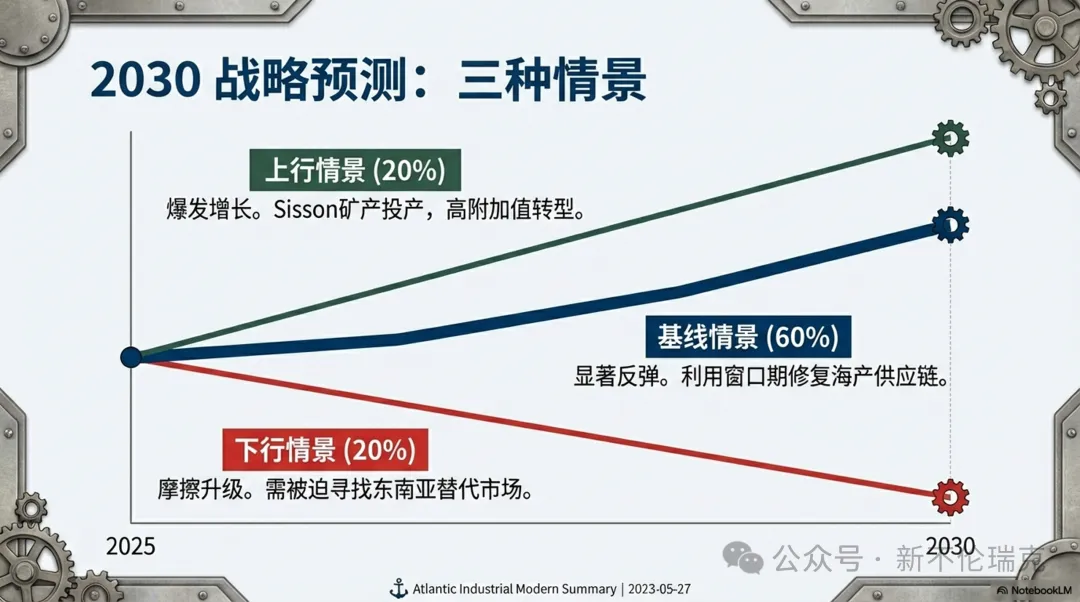
Looking ahead to 2030, NB's trade with China is set to show a pattern of "stable volume, rising quality". High-end agricultural products such as lobster, sea cucumber and blueberries will continue to dominate exports, while digital services and green-energy technology cooperation will become new growth drivers. The provincial government is promoting small and medium-sized enterprises' entry into the Chinese market through the "New Brunswick–China Trade Promotion Program", with the goal of raising exports to China to C$1 billion by 2030.
Conclusion
The trade relationship between New Brunswick and China is a story of evolution from resource complementarity to policy contest. Against the backdrop of a restructuring global trade order, New Brunswick needs to find its balance in the three-way contest among China, the United States and Canada, in order to achieve economic diversification and sustainable development.
Cited Works
Research Report on Trade Between New Brunswick and China
Statistics Canada International Trade Data, accessed March 2, 2026, https://www150.statcan.gc.ca/n1/pub/71-607-x/71-607-x2019005-eng.htm
New Brunswick Export Statistics 2024, accessed March 2, 2026, https://www2.gnb.ca/content/gnb/en/departments/onb.html
Canada-China Trade Relations - Global Affairs Canada, accessed March 2, 2026, https://www.international.gc.ca/country-pays/china-chine/relations.aspx?lang=eng
China-Canada Tariff War 2025 - Reuters, accessed March 2, 2026, https://www.reuters.com/world/americas/canada-china-tariff-war-2025
New Brunswick Lobster Exports to China, accessed March 2, 2026, https://www.lobstercouncil.ca/exports/china
This article was originally published on the WeChat public account 「新不伦瑞克」 (New Brunswick Today); original link: mp.weixin.qq.com/s?__biz=MzI4Mjc3NDcyMg==&mid=2247485149&idx=2&sn=22e683a2987b2f5b92048601491c5f83&chksm=eb959b70dce212660ea3097adc52fca4827f05a7461f883f7c5c69091f81a91f6056e45995ea&scene=178&cur_album_id=4378684396283723780&search_click_id=