
November 5, 2026
Louis B. Mayer: From Saint John to Hollywood — the MGM Empire's Tsar
Louis B. Mayer fled persecution in the Russian Empire, grew up collecting scrap metal on the streets of Saint John, and went on to build Metro-Goldwyn-Mayer into Hollywood's most powerful studio. This is the story of how he industrialized stardom, exported American middle-class values around the world, weaponized film in politics — and was finally driven out of the empire he built.
Condensed Version
Short on time? Read this condensed version instead of the full article.
Reinvented identity and the origin of a business logic. Mayer was a Ukrainian Jewish immigrant who fled persecution in Russia and spent his early years in the scrap-metal trade in Saint John, Canada. That experience at the bottom not only drove him to falsify his birthplace and birthday in a politically symbolic act of "identity reconstruction", it also taught him the industrial logic of "extracting value from scrap" — the core idea behind his later packaging of raw human material into high-priced commercial stars.
The MGM empire's "star system". Mayer and Irving Thalberg formed a two-headed management model pairing "administration and aesthetics", building Hollywood's most powerful studio system. He industrialized the charm of stars completely, using extreme paternalistic management — physical transformation, private-life supervision and skills training — to turn actors into highly standardized fixed assets, achieving a highly consistent brand image.

Vertical integration and global cultural hegemony. Through "vertical integration" — controlling production, distribution and exhibition — and the "block booking" mechanism, MGM squeezed out independent producers and forced theatres to buy mediocre films in bundles. This mechanism not only maximized profits, it also quietly exported the American middle-class values Mayer championed to the world (above all through the United Kingdom as the overseas hub), forming a transnational cultural hegemony.
Political manipulation and a moral shadow. Mayer turned the powerful film-industry machine into a political weapon. In the 1934 California gubernatorial election, he attacked the socialist candidate with "fake newsreels" acted by hired players and forced political donations, and is regarded as the originator of modern "political black PR" and "fake news". At the same time, behind the healthy entertainment he built lay extremely cruel exploitation of individuals — for example, the long-term drug control, dietary exploitation and harassment imposed on the actress Judy Garland.
The empire's dissolution and historical echoes. The 1948 Paramount Decree forced MGM to divest its theatre chain, destroying the monopoly foundation on which it depended (the block-booking model collapsed). As the external legal environment changed drastically and audience tastes shifted, Mayer, clinging to traditional aesthetics, was crushingly defeated in the conflict and was driven out of MGM in 1951, marking the end of Hollywood's era of "paternalistic dictatorship".
Full Article
Louis B. Mayer (1884–1957) was one of the most influential giants of the global entertainment industry in the twentieth century. His life was not only a classic immigrant success story, but also a microcosm of how Hollywood's "Golden Age" was institutionalized and how its cultural hegemony was built. From a refugee fleeing war and poverty in Tsarist Russia, to a boy picking up scrap on the streets of Saint John, New Brunswick, Canada, and then to the "film industry tsar" who controlled Metro-Goldwyn-Mayer (MGM) and defined mainstream American values, Mayer's life was full of complex self-reinvention and strategic gambles. Through the "star system" he not only industrialized charm, he also used film as a medium to push a cultural model built on family, patriotism and traditional virtues out to the world, profoundly shaping global mass-culture identity.
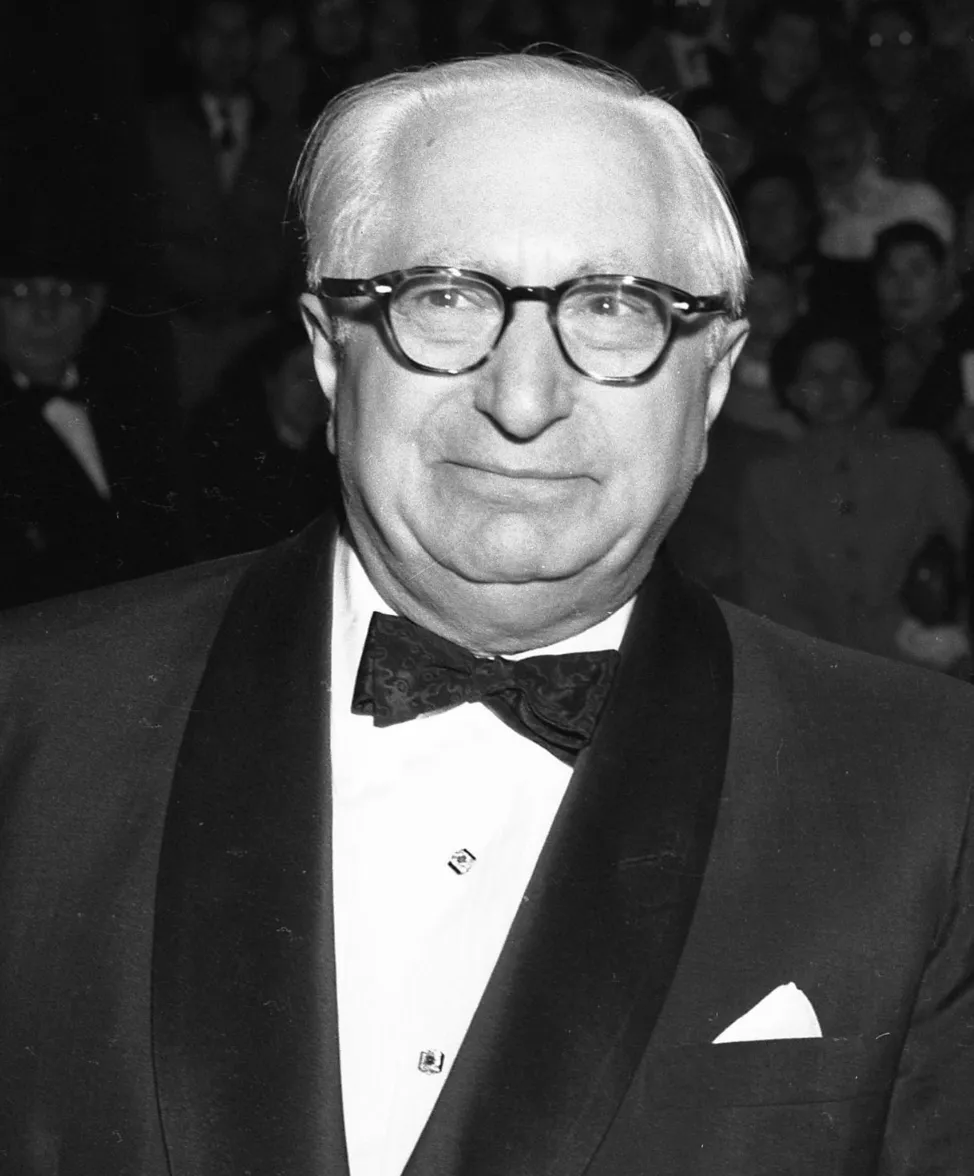
The "film industry tsar", Louis B. Mayer (Louis B. Mayer), who ruled Hollywood.
To see through this complex historical figure and the industrial logic behind him, this research report deconstructs him in depth along three dimensions: at the individual level, identity reinvention and the formation of the will to power; at the institutional level, the studio system and market-control mechanisms; and at the transnational level, the export of cultural hegemony and diplomatic-political manoeuvring. This three-layer structure aims to turn the rhetorical concept of the "myth builder" into a mechanism-level description supported by evidence, thereby revealing the capital, technology and ideological forces behind Hollywood's global expansion.
Chapter 1: The Prehistory of an Identity — From the Ukrainian Margins to Survival Training in Saint John
Louis B. Mayer's early roots lay deep in the violent political upheavals of Eastern Europe at the end of the nineteenth century. His birth story is full of fog deliberately created for self-mythologizing, reflecting the deep psychology of early Jewish immigrants who, having fled persecution, longed to fit into Western society by reconstructing their identity.
1.1 The Mystery of His Birth: Geographical Fog Layered with Political Symbolism
Although Mayer long claimed publicly that he was born in Minsk (now the capital of Belarus) on July 4, 1885 (American Independence Day), thereby displaying extreme loyalty to his second homeland, the United States, historical analysis and authoritative biographies show that his real identity was that of a Ukrainian Jewish descendant named Lazar Meir. His birthplace was Dymer, near Kyiv, and his real date of birth was July 12, 1884.

Street scene in Dymer, 32 kilometres from Kyiv.
This embellishment of his birthday and birthplace was the first successful "production" of Mayer's life — he packaged his own birth as an act with political symbolism, dissolving the lowliness of a Russian exile and replacing it with a footnote to the American spirit. This identity reconstruction was not only commercial packaging, but also psychological compensation: under the rule of Alexander III, extreme anti-Jewish laws and the threat of pogroms forced the Mayer family to abandon their homeland, and this forced migration made "rewriting the past" a survival strategy.
1.2 The Survival Field of Saint John's North End: The Philosophical Lessons of the Scrap-Metal Trade
Around 1892, the Mayer family settled in Saint John, the port city of New Brunswick, Canada. At the time, Saint John was a city booming on Atlantic shipping and heavy-industry expansion, and the North End, where the Mayer family lived, was a typical immigrant neighbourhood and the industrial heart of the city.

North End, Saint John
"His father started a scrap-metal recycling business called J. Mayer & Son. As an immigrant with no technical skills, he found it very hard to make a living. Young Louis left school at twelve and worked with his father to help support the family. He pushed a handcart marked 'scrap buyer' through the streets, collecting whatever scrap metal he could find. When John Wilson, the owner of a tinware business, saw him pushing the cart, he began giving him some useless copper offcuts. Mayer later regarded Wilson as his first 'partner' and his best friend. Wilson recalled being impressed by the boy's good manners and clever character. Later, whenever Mayer returned to Saint John, he would lay flowers at Wilson's grave, as he would at his mother's grave." — Wikipedia
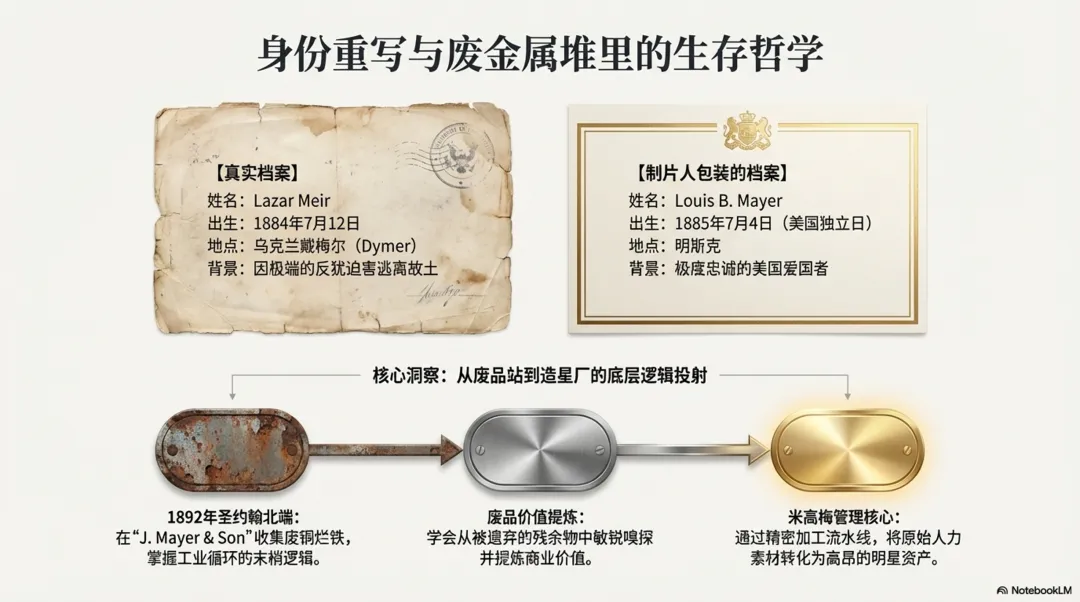
On the surface, the Mayer family's "J. Mayer & Son" scrap-metal business was a desperate measure under extreme poverty, but in industrial terms, this business was actually the far end of the modern steel industry's recycling loop. Louis, who left school at twelve to pull a handcart, not only developed a sharp nose for residual value in the course of collecting scrap metal, copper sheets and old canvas, he also deeply experienced the anti-Jewish humiliation early immigrants faced. This experience of "extracting value from scrap" later became the core logic of his management of MGM: through precise processing (production and packaging), raw human material (actors) was turned into high-priced commercial assets (stars).
"In his spare time, he often lingered near the York Theatre, sometimes paying to watch live vaudeville performances. He gradually fell in love with the entertainment business." — Wikipedia
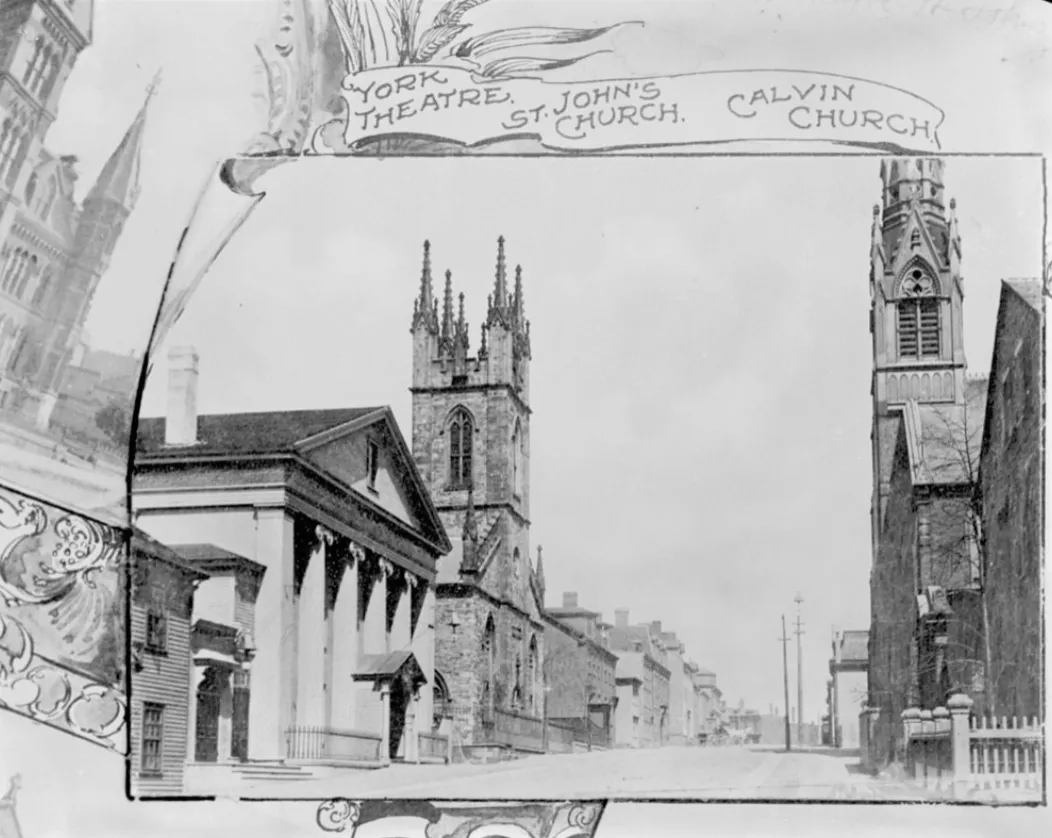
The only image labelled "York Theatre" found on the Library and Archives Canada website (1900–1925). It looks very much like the Stone Church at 87 Carleton St, Saint John; the original theatre was probably next to it, but the building is no longer there today. The church building across the street has also had its top structure removed. The national archives site has no address information. Readers with relevant background material are welcome to share it. The York Theatre was not the Imperial Theatre as we had originally thought; an earlier article from this public account was wrong on this point.
Family members:
- Jacob Mayer, father / traditional scrap dealer — described as a classic case of someone lacking business ability. He sparked Louis's obsession with professional management and absolute power.
- Sarah Mayer, mother — the object of Mayer's lifelong worship. She became the central archetype of the "mother worship" and family bonds in MGM films.
- Rudolph Mayer, younger brother / scrap-metal broker — representing the Mayer family's roots in Saint John; he stayed in the city running the business for a long time and was the link through which Mayer maintained his connection to his homeland.
- John Wilson, spiritual mentor / tin merchant — the local businessman who gave Mayer his first "scrap" support. He laid the warm foundation of mentoring younger people within Mayer's "paternalistic management".
Chapter 2: The Dawn of a Business Myth — From Boston to Haverhill as a Strategic Springboard
On January 2, 1904, Louis B. Mayer left Saint John, a place that had made him feel cold, hungry and miserable, and headed for Boston, Massachusetts. In Boston, he did not immediately enter the film business, but continued in the scrap-metal trade, and when business was poor he kept himself going with odd jobs. In June 1904, he married Margaret Shenberg, and the added family responsibilities further fuelled his ambitions for expansion.
2.1 The Orpheum Theatre in Haverhill: Brand Reinvention in Practice
In 1907, Mayer bought a rundown theatre called the "Orpheum" in Haverhill. At the time, film exhibition was still street-level entertainment with a poor reputation. Mayer showed extraordinary public-relations instincts: he realized that to attract the middle class, the cinema had to be upgraded from a "black box" into a "temple of morality". In 1912, by screening the religious film From the Manger to the Cross, he successfully won the trust of religious people and traditional families — a strategy that later became the blueprint for MGM's "family-oriented" production policy.
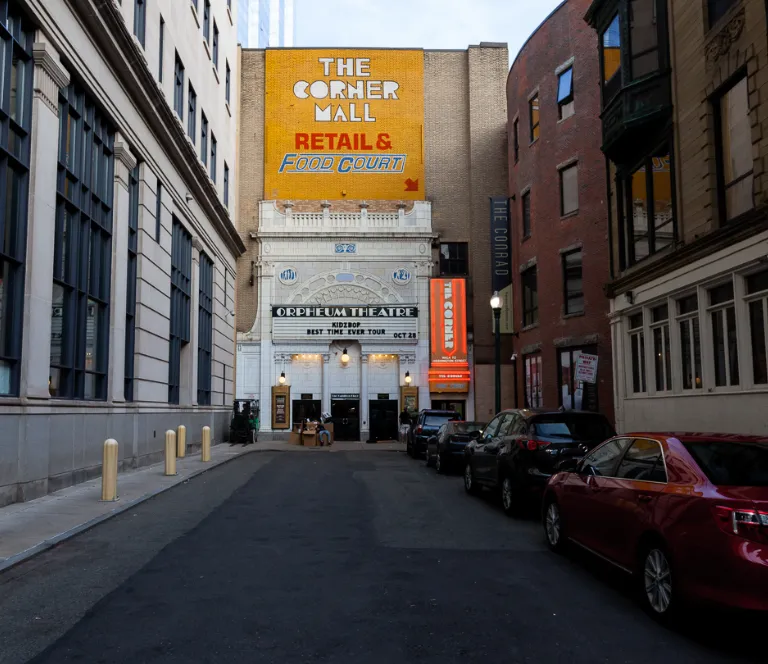
The Orpheum Theatre in Boston.
2.2 The Birth of a Nation: Seed Capital as a Political Chip
Mayer's financial breakthrough came from his gamble on D. W. Griffith's epic The Birth of a Nation. Without having fully watched the film, he raised $25,000 to buy its exclusive distribution rights for New England. According to a 1936 in-depth report in The New Yorker, this speculation brought him more than $100,000 in profit. The money not only provided the financial foundation for his move to Los Angeles, it also taught him how to manipulate socially controversial films with grand narratives for outsized profits. In 1936, he became the first executive in the United States to earn an annual salary of $1 million. Until 1944, he remained the highest-paid executive in the country.
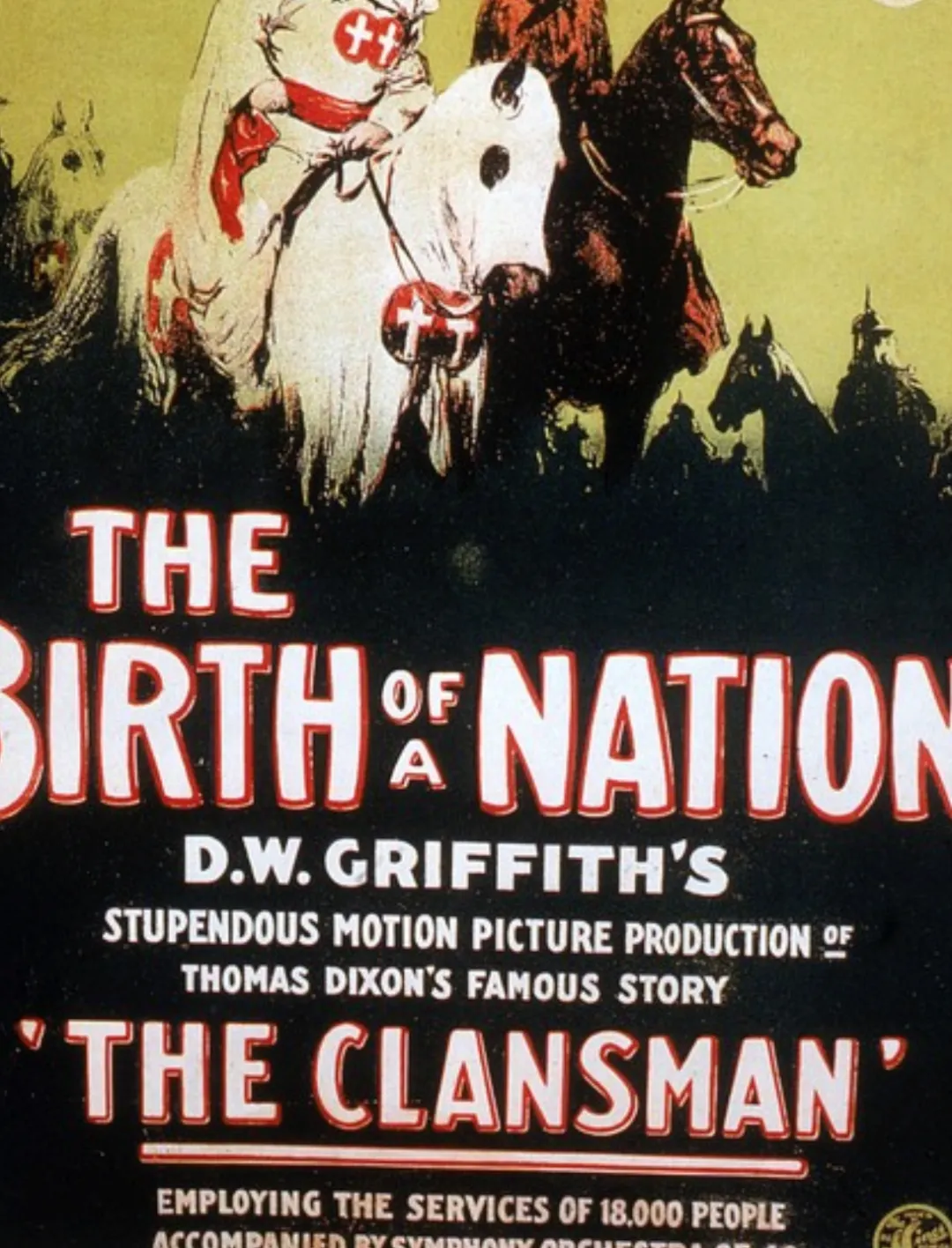
Poster for The Birth of a Nation, Mayer's first great gamble in his film career.
Chapter 3: The Coronation of the Film Tsar — The Industrial Logic of the MGM Empire
In April 1924, theatre-chain magnate Marcus Loew led the merger of Metro, Goldwyn and the Louis B. Mayer Pictures Corporation. Mayer was appointed vice-president and head of Los Angeles operations, marking the establishment of Hollywood's most powerful studio system.
The now-famous opening logo of Metro-Goldwyn-Mayer (MGM).
3.1 The Twin-Star Power Mechanism: Administrative Talent Meets Aesthetic Instinct
Mayer knew the limits of his own administrative genius. He chose Irving Thalberg as head of production, forming a two-headed management model of "Mayer in charge of diplomacy and capital, Thalberg in charge of scripts and aesthetics". Before Thalberg's death in 1936, this complementarity made MGM the only studio to remain continuously profitable during the Great Depression. Mayer's reliance on Thalberg reflected his managerial pragmatism: he could tolerate a "genius" offending him for the sake of quality, but never losses caused by mediocrity.
3.2 The Industrialization of the Star System: Charm Managed as a Fixed Asset
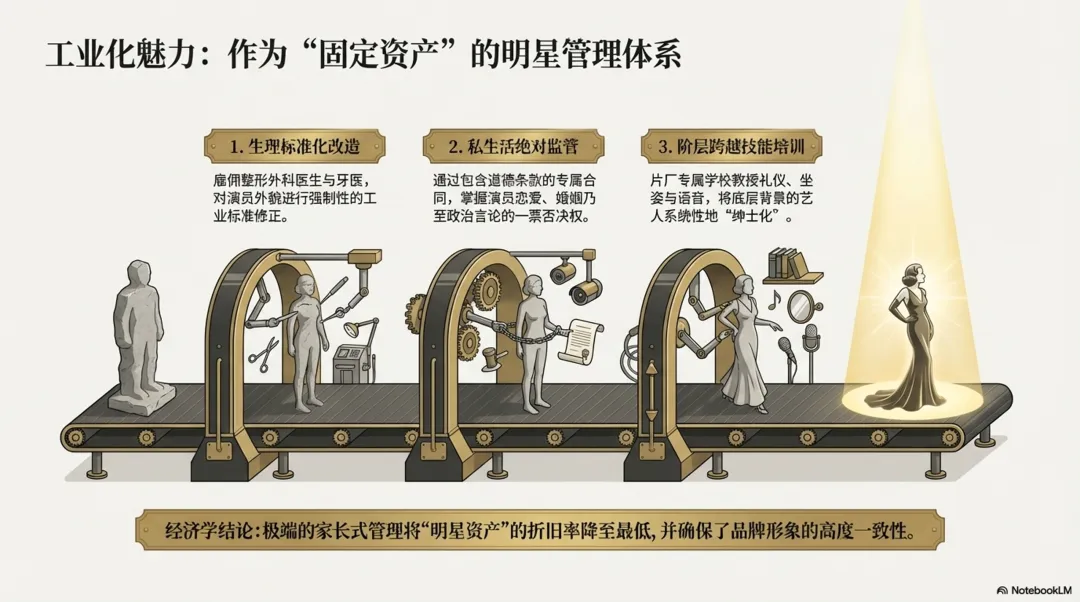
Mayer often said that stars are not born — they are made, coldly and according to precise logic. MGM not only gave actors roles, it also provided a complete programme of physical and social-image overhaul:
- Physical transformation: hiring plastic surgeons, dentists and image designers to standardize the appearance of Garbo, Gable and others.

Greta Garbo (September 18, 1905 – April 15, 1990). In 1999, the American Film Institute ranked her the 5th greatest actress of the century. Hitler is said to have praised her as "the only person who could approach me without being searched, because her face is the limit of human evolution".
- Private-life supervision: through long-term exclusive contracts, Mayer held veto power over actors' marriages, romances and even political statements.
- Skills training: a dedicated school inside the studio taught etiquette, posture and ways of speaking, aiming to "gentrify" performers from immigrant or working-class backgrounds.
Although this extreme paternalistic management was much criticized (the Judy Garland case, for example), from an economic point of view it kept the depreciation rate of "star assets" to a minimum and achieved a highly consistent brand image.
Scale indicators:
- Site area: 185 acres, spread over 6 lots in Culver City — exceeding the scale of local administration, forming a self-governing "company town".
- Total workforce: about 6,000 full-time employees — an extremely high level of division of labour, supporting an annual output of 50–60 A-pictures.
- Power supply: its own power station, enough to supply a small town of 25,000 people — core infrastructure under its own control, ensuring shooting schedules were not disrupted by outside interference.
- Star roster: long-term contracts covering more than 100 globally known stars — forming an insurmountable competitive barrier and brand loyalty.
- Personal income: annual salary of about $1.3 million in 1937 — Mayer became the highest-paid individual in the United States, symbolizing the leap in the entertainment industry's social status.

Chapter 4: Transnational Cultural Hegemony — Global Distribution Mechanisms and the Pre-Setting of Ideology
Louis B. Mayer's most far-reaching influence on Hollywood lay in the transnational distribution network he built. This network was not only a source of wealth, but also the "conveyor belt" that carried American values around the world.
4.1 Vertical Integration and "Block Booking": An Algorithm for Excluding Competition
Economic-history research shows that Hollywood's hegemony in the 1930s was built on "vertical integration" — the studio simultaneously controlling production, distribution and exhibition. At MGM, Mayer vigorously promoted the "block booking" system: to obtain one major production starring Garbo or Gable, a theatre had to buy a dozen or even several dozen mediocre B-pictures at the same time.
The social effects of this mechanism were:
- Content homogenization: since exhibition rights were pre-sold, studios could mass-produce mediocre works conforming to a certain moral model without worrying about the market risk of any single film.
- Market lock-in: independent producers and European filmmakers were squeezed out of the market because they could not enter screening slots already filled by "booked blocks".
- Cultural dependence: as global audiences watched these bundled films over a long period, they unconsciously absorbed the American middle-class morality Mayer promoted.

4.2 The British Market: A Cultural Hub of Mutual Dependence
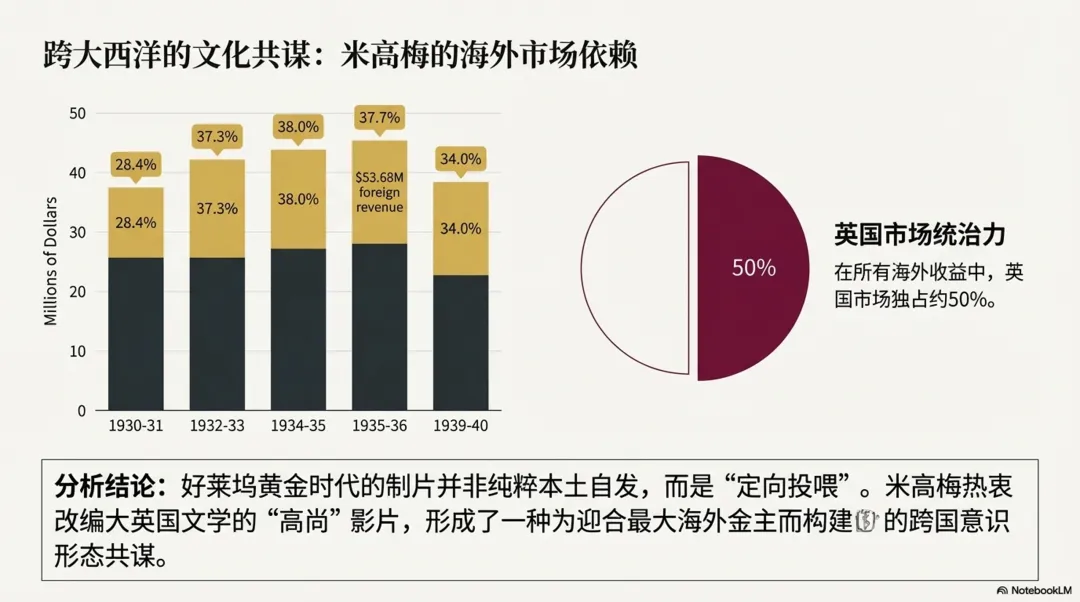
Empirical research shows that in the 1930s, MGM's overseas revenue typically accounted for 35% to 40% of total revenue. Of this, the British market accounted for about 50% of all overseas earnings.
| Fiscal year | Domestic rental revenue | Foreign rental revenue | Foreign share |
|---|---|---|---|
| 1930–31 | $69.89M | $27.68M | 28.4% |
| 1932–33 | $70.02M | $41.66M | 37.3% |
| 1934–35 | $77.65M | $47.56M | 38.0% |
| 1935–36 | $88.54M | $53.68M | 37.7% |
| 1939–40 | $103.87M | $53.50M | 34.0% |
The data show that MGM's production direction was not purely spontaneous market behaviour, but highly attuned to overseas audiences led by Britain. This also explains why MGM made so many "elevated" films adapted from British literature during this period, forming a kind of "transatlantic cultural complicity".
Chapter 5: Political Actor — The 1934 Election and the Birth of Media Manipulation
Louis B. Mayer not only shaped the screen utopia, he also helped shape real political opinion. His conduct in the 1934 California gubernatorial election is regarded as the origin of modern "political black PR" and "fake news".
5.1 Against Upton Sinclair: Film Technology as a Weapon
In 1934, the famous socialist writer Upton Sinclair launched the "End Poverty in California" (EPIC) campaign and won the Democratic nomination for governor. Sinclair's platform threatened to raise taxes on film studios and even suggested the state government take over idle studios so unemployed performers could make films — which enraged Mayer.
Mayer, as chairman of the California Republican State Committee, deployed MGM's production machine against Sinclair:
- "Fake newsreels": at Irving Thalberg's direction, director Felix Feist shot a series of short films called "California Election News". Disguised as impartial man-on-the-street interviews, they actually hired extras with heavy foreign accents and haggard looks (prototypes of "Bolsheviks") to declare their support for Sinclair, while letting neat-looking, well-mannered people support the Republican candidate, Frank Merriam.
- Image appropriation: the Merriam camp published photographs in newspapers purporting to show "jobless drifters flooding into California", which were actually stills stolen from the Warner Bros. film Wild Boys of the Road.
- Forced political donations: Mayer forcibly deducted employees' salaries as political contributions, provoking strong anger from liberal screenwriters such as Herman Mankiewicz.
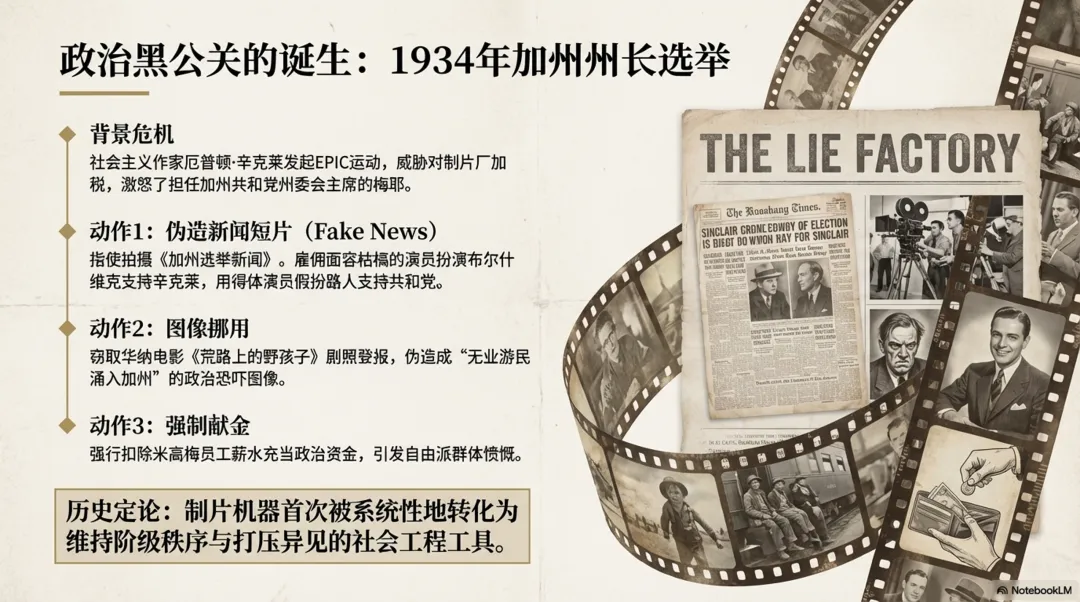
Sinclair was ultimately defeated. In his subsequent memoirs, he called MGM's campaign "The Lie Factory". This episode proved that the media power Mayer controlled was not only for entertainment, but also a tool of social engineering for maintaining class order.
5.2 The Cold War Context and the House Un-American Activities Committee (HUAC)
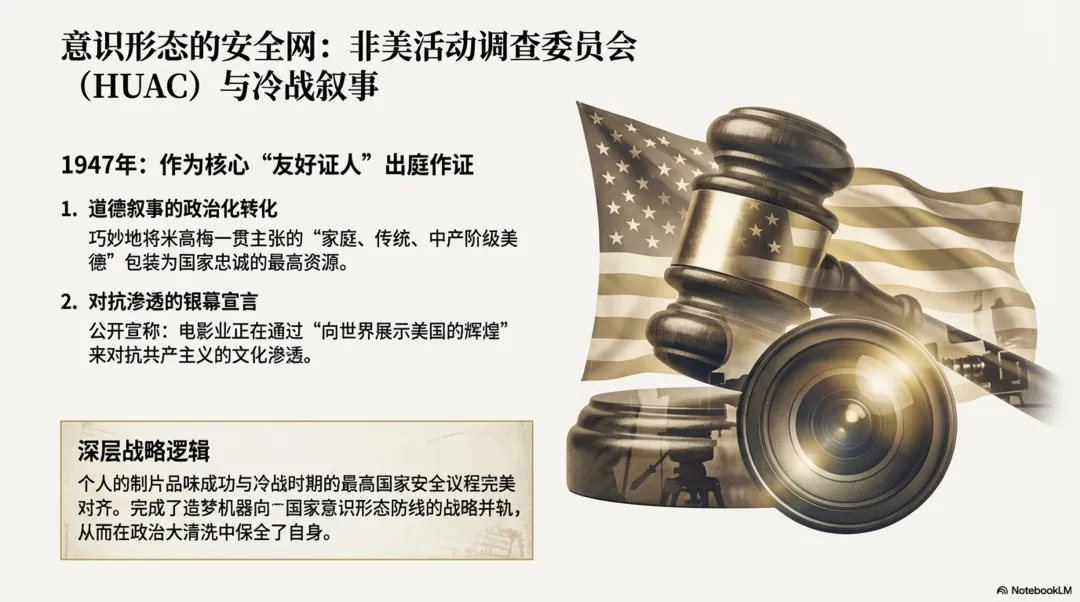
In 1947, Mayer testified before the House Un-American Activities Committee as a "friendly witness". He turned "moral narrative" into a resource of national loyalty, claiming the film industry was fighting Communist infiltration by "showing the world the glory of America". This testimony reflected how he successfully aligned his personal production tastes (middle-class virtues) with the national-security agenda of the Cold War era.
Chapter 6: The Evidence of the Moral Shadow — Judy Garland and Paternalistic Exploitation
Behind the "healthy entertainment" Mayer built lay extremely cruel discipline of individuals. The tragedy of Judy Garland is the most extreme case of this system.
6.1 The Star as Test Subject: Drugs and Physical Control
To shape Garland into a profitable "girl next door", Mayer and the studio subjected her to systematic physical exploitation:
- Drug discipline: amphetamines ("pep pills") to sustain high-intensity shooting energy, then barbiturates ("downers") to force sleep — long-term drug abuse that laid the foundation for Garland's addiction tragedy in the second half of her life.
- Dietary exploitation: Mayer was extremely sensitive about Garland's weight, once berating her in public and restricting her food intake, even when she was extremely hungry on set.
- Allegation matrix: in her memoir notes, Garland alleged that Mayer repeatedly subjected her to physical harassment and sexual assault.
6.2 An Evidence Matrix for the Contested Issues
| Contested issue | Core allegation | Evidence sources | Assessment |
|---|---|---|---|
| The Judy Garland harassment case | Mayer subjected Garland to improper physical contact and sexual coercion in his office. | Garland's own unfinished memoir notes; Gerald Clarke's biography. | Highly contested: based on the account of the person concerned, but lacking third-party physical evidence, reflecting the power imbalance of the studio era. |
| The anti-union Oscar theory | The Academy was founded to offer spiritual rewards in place of substantive union negotiations. | Mayer's famous remark quoted in Eyman's biography; 1920s labour-relations archives. | Generally accepted: consistent with the social trend of 1920s "welfare capitalism" and anti-unionism. |
| The 1934 election fraud | Professional actors were used to fake man-on-the-street interviews and mislead voters. | Greg Mitchell's research; MGM archive short-film material. | Confirmed: established by historians through tracing the original material and participants (director Felix Feist). |
Chapter 7: Homeland and Honours — The Memory Politics of Saint John
Mayer's relationship with Saint John, New Brunswick, Canada, shows an extremely complex side of his character: fear of his early poverty coexisting with a longing for identification with his hometown.
7.1 The 1939 University of New Brunswick (UNB) Honorary Degree
In May 1939 (note: not 1938), Mayer returned to Fredericton to receive an honorary Doctor of Laws degree from UNB. This honour meant a great deal to him, because it marked his formal transformation from a "scavenger boy of Saint John's North End" into a "cultural leader" recognized by an elite academic institution. In his letter to the university, he expressed the highest respect — regarded as his final step in concealing his humble educational background and completing his crossing of social class.
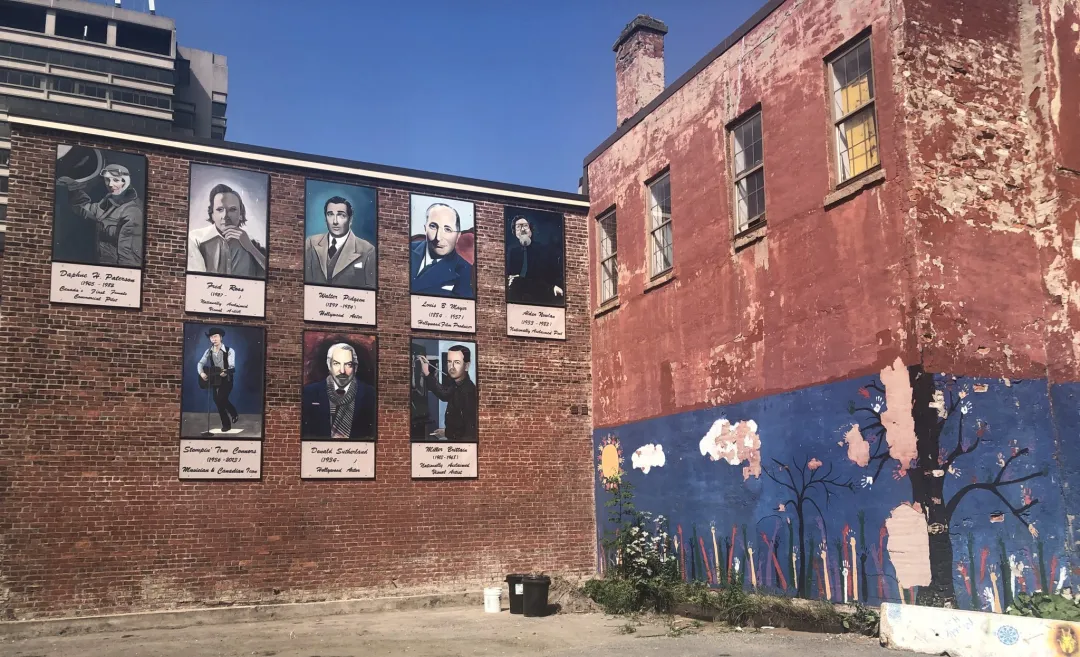
Louis B. Mayer on the Saint John Wall of Fame (first row, second from right).
7.2 Saint John's Material Legacy: Fernhill Cemetery and Jewish Heritage
Mayer's feelings for Saint John were largely bound up with remembrance of his mother. In 1950, he donated a memorial chapel for his mother inside Fernhill Cemetery in Saint John.
- Fernhill Cemetery chapel — a religious and memorial space — commemorating the mother of Mayer and Nathan Cummings; a symbol of Saint John's Jewish history.
- The former Burpee Building site — the family's industrial base — where his younger brother Rudolph ran the scrap-metal trade, witnessing the accumulation of the family's wealth.
- Donation to Saint John General Hospital — charitable medical funding — an attempt to establish his standing in his hometown as a "philanthropist" and "successful son returned home".

Chapter 8: The Empire's Dissolution — The Paramount Decree and the End of the Studio System
Mayer's rule ended with a drastic change in the external legal environment. The 1948 Paramount Decree was the watershed.
8.1 The Collapse of Vertical Integration: Forced Divestiture of the Theatre Chain
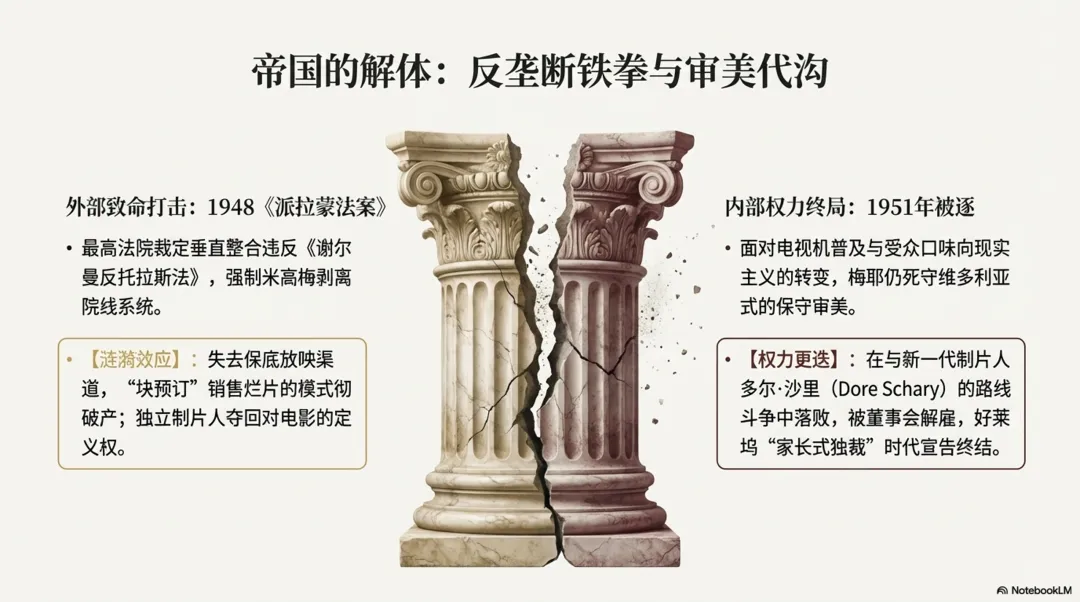
In 1948, the Supreme Court ruled that studio control of theatre chains violated the Sherman Antitrust Act. MGM was forced to divest its most stable source of income — the theatre system.
- Economic ripple: without the guaranteed exhibition of the theatre chain, Mayer's model of selling mediocre films through "block booking" completely failed.
- Competition returns: independent producers gained the right to negotiate directly with theatres, breaking Mayer's power to define "what a film is".
8.2 Driven Out of the Empire in 1951
As television spread and audience tastes turned toward realism, Mayer still clung to his conservative Victorian aesthetics. He clashed violently with a new generation of producers inclined toward social commentary, led by Dore Schary. In 1951, in a final showdown with the Loew's board of directors, Mayer was crushingly defeated and forced into retirement, marking the end of Hollywood's era of "paternalistic dictatorship".
Chapter 9: Conclusion — The Historical Echoes of the Myth Builder
Louis B. Mayer's life reveals how modern mass culture was driven by one man's sense of personal deprivation. The marginalization and discrimination he experienced in Saint John were transformed into an extreme craving, on screen, for warmth, order and dignity.
By establishing the star system and the Academy Awards, he not only created a company, but also created a global cultural logic that remains deeply rooted in Hollywood's DNA to this day. Although his methods are full of controversy by modern ethical standards — from manipulating political elections to exploiting underage performers — it cannot be denied that he elevated film from crude street vaudeville into a sacred art form with global influence.
His story also reminds us that Hollywood's cultural hegemony was no accident: it was the joint product of precise industrial mechanisms (such as block booking), sharp political instincts (such as the 1934 campaign), and deep psychological drives (such as identity reconstruction). Louis B. Mayer ultimately turned the fantasy of a Saint John scrap boy into a visual dream shared by the whole world.
Cited Works
Key research points on the life of Louis B. Mayer
- 115 years since Saint Johner started journey to Hollywood royalty, accessed February 25, 2026, cbc.ca/news/canada/new-brunswick/mgm-movie-mogul-louis-mayer-saint-john-1.4963642
- The Myth Builder of Hollywood: Suggestions for Improving and Revising the Report on the Life of Louis B. Mayer and His Transnational Cultural Influence
- Louis B. Mayer - Canada's Walk of Fame, accessed February 25, 2026, canadaswalkoffame.com/inductees/louis-b-mayer
- Louis B. Mayer | History | Research Starters - EBSCO, accessed February 25, 2026, ebsco.com/research-starters/history/louis-b-mayer
- Louis B. Mayer | The Canadian Encyclopedia, accessed February 25, 2026, thecanadianencyclopedia.ca/en/article/louis-b-mayer
- Louis B. Mayer - Grokipedia, accessed February 25, 2026, grokipedia.com/page/Louis_B_Mayer
- Immigration and Real Estate Analysis for Canada and New Brunswick, drive.google.com/open?id=1c-lzv2cnIizmtNyTTdGlo4KNvJP8gyrFq1MVVYyaQBg
- Non-Retail Business Enterprises | Open for Business, accessed February 25, 2026, communitystories.ca/v2/open-for-business_en-affaires/story/non-retail-business-enterprises
- Louis B. Mayer - Wikipedia, accessed February 25, 2026, en.wikipedia.org/wiki/Louis_B._Mayer
- Walking Tour - Fernhill Cemetery, accessed February 25, 2026, fernhillcemetery.ca/walking-tour
- Louis B. Mayer - Hollywood Walk of Fame, accessed February 25, 2026, walkoffame.com/louis-b-mayer
- Judy Garland – The Tragedy of the Girl Next Door | Screen Argyll, accessed February 25, 2026, screenargyll.co.uk/.../Judy-Garland-–-The-Tragedy-of-the-Girl-Next-Door.pdf
- Paramount Decree Definition - Intro to Film Theory Key Term | Fiveable, accessed February 25, 2026, fiveable.me/key-terms/introduction-to-film-theory/paramount-decree
- Paramount Revisited - Hofstra Law Review, accessed February 25, 2026, hofstralawreview.org/.../21_21HofstraLRev5051992-1993.pdf
- United States v. Paramount Pictures, Inc. - Wikipedia, accessed February 25, 2026, en.wikipedia.org/wiki/United_States_v._Paramount_Pictures,_Inc.
- Block Booking: The Root of All Evil in the Motion Picture Industry, accessed February 25, 2026, cobbles.com/simpp_archive/blockbook_intro.htm
- Block booking - Wikipedia, accessed February 25, 2026, en.wikipedia.org/wiki/Block_booking
- What Was the Paramount Decree and Why Was It Important to Hollywood, accessed February 25, 2026, beverlyboy.com/filmmaking/what-was-the-paramount-decree-and-why-was-it-important-to-hollywood
- Hollywood Studios, Independent Producers and International Markets, accessed February 25, 2026, assets.henley.ac.uk/.../IBH-2014-07_Miskell_and_Li__2_-mtime20170410170907_2020-10-14-084306.pdf
- Hollywood's Foreign Earnings during the 1930s - ResearchGate, accessed February 25, 2026, researchgate.net/publication/239595348/Hollywood's_Foreign_Earnings_during_the_1930s
- From Outsiders to Insiders? Strategies and Practices of American Film Distributors in Postwar Italy, accessed February 25, 2026, cambridge.org/core/journals/enterprise-and-society/article/from-outsiders-to-insiders-strategies-and-practices-of-american-film-distributors-in-postwar-italy/4DEDB856DAF86A1BB40769F66A540BEE
- The Case of United Artists in Britain in the 1930s and 1940s, accessed February 25, 2026, ebha.org/ebha2005/pdf papers/Miskell.pdf
- CAMPAIGNS, INC. :: Online Lobby - TimeLine Theatre Company, accessed February 25, 2026, timelinetheatre.com/campaigns-inc-lobby
- A Socialist's Campaign for California Governor, And the Dirty Hollywood Politics That Sunk His Campaign, accessed February 25, 2026, pbssocal.org/shows/lost-la/the-socialist-who-won-a-democratic-primary-and-the-dirty-hollywood-politics-that-sunk-his-campaign
- Where It All Began: The Dawn of "Fake News" - CounterPunch.org, accessed February 25, 2026, counterpunch.org/2018/05/01/where-it-all-began-the-dawn-of-fake-news
- The Political History of Classical Hollywood: Moguls, writers and the Great Depression, accessed February 25, 2026, repository.londonmet.ac.uk/1136/3/WheelerMark_1930s Hollywood and the Great Depression.pdf
- 1934 California gubernatorial election - Wikipedia, accessed February 25, 2026, en.wikipedia.org/wiki/1934_California_gubernatorial_election
- Metro-Goldwyn-Mayer | JH Wiki Collection Wiki | Fandom, accessed February 25, 2026, jhmovie.fandom.com/wiki/Metro-Goldwyn-Mayer
- 'Mank' Is Fake News About Fake News - The American Prospect, accessed February 25, 2026, prospect.org/2021/01/22/mank-is-fake-news-about-fake-news
- The World Was at Stake: Three Friendly HUAC Hollywood Witnesses, accessed February 25, 2026, historymatters.gmu.edu/d/6442
- 1947 Louis B Mayer MGM Co Founder HUAC Testimony (Outtake), accessed February 25, 2026, youtube.com/watch?v=-ETLYiezMCo
- Show Trial: Hollywood, HUAC, and the Birth of the Blacklist, accessed February 25, 2026, dokumen.pub/show-trial-hollywood-huac-and-the-birth-of-the-blacklist-9780231547468.html
- The True Story Behind the Judy Garland Movie Judy | TIME, accessed February 25, 2026, time.com/5684673/judy-garland-movie-true-story
- Hollywood's long ugly history with sexual harassment - 570 News, accessed February 25, 2026, kitchener.citynews.ca/2017/10/10/hollywoods-long-ugly-history-with-sexual-harassment
- Melt the Crown - Current Affairs, accessed February 25, 2026, currentaffairs.org/news/2021/07/melt-the-crown
- How accurate is 'Mank,' the movie about the movie 'Citizen Kane'?, accessed February 25, 2026, poynter.org/fact-checking/2021/how-accurate-is-mank-the-movie-about-the-movie-citizen-kane
- The End of the Paramount Antitrust Consent Decrees: A Brief Look at Movie History and the Future, accessed February 25, 2026, theantitrustattorney.com/the-end-of-the-paramount-antitrust-consent-decrees-a-brief-look-at-movie-history-and-the-future
This article was originally published on the WeChat public account 「新不伦瑞克」 (New Brunswick Today); original link: mp.weixin.qq.com/s?__biz=MzI4Mjc3NDcyMg==&mid=2247485331&idx=1&sn=b0cd0065b7ab4c9a8ea0b3c6f3e129a8&chksm=eb959a3edce2132872e86861264027b37bbc9679bce1faa56b9526ec8b40121e7fb9f8d03d8e&scene=178&cur_album_id=4378684396283723780&search_click_id=