
November 5, 2026
The Industrial Hegemony of Atlantic Canada: A Full History of the Irving Family, Its Geography, and Its Strategic Transformation in the 21st Century
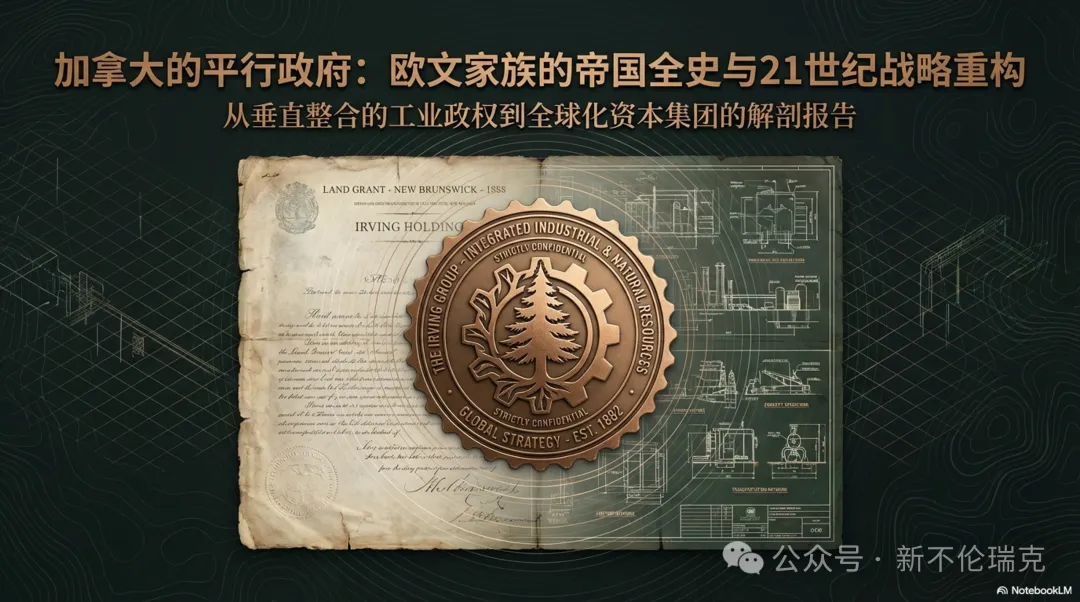
From a Scottish settler clearing 200 acres in Kent County to an industrial empire that runs Canada's largest refinery, the Irving family built a "parallel government" in New Brunswick. This report traces the family's history and geography, the 2025 arrival of its first non-family CEO, the end of its newspaper monopoly, and the green-energy bets that will shape the province's next thirty years.
Condensed Version
Short on time? Read this condensed version instead of the full article.
History and geographical footprint
The Irving family descends from Scottish immigrants of the nineteenth century; their early settler experience shaped the family's attachment to natural resources. J.D. Irving laid the foundations of a diversified business in 1882, and K.C. Irving, holding to a doctrine of "extreme vertical integration", founded Irving Oil in 1924 and formally built a vast industrial empire. The family's centre of residence and power moved gradually from Kent County to the City of Saint John, and then extended internationally to the United States and Britain.
Strategy and management transformation in the 21st century
With the three brothers' division of the empire and the successive deaths of its core figures, the Irving empire is undergoing the greatest upheaval in a century. Its crown jewel, Irving Oil, appointed its first non-family CEO in 2025, marking a shift from family dictatorship to a modern professional governance structure. Meanwhile, the JDI division is moving toward high-tech forestry and green renewable energy (such as wind farm construction). In addition, the family completely divested its traditional print-media assets in 2022, ending its long-standing newspaper monopoly in the province.
Economic hegemony and social controversy
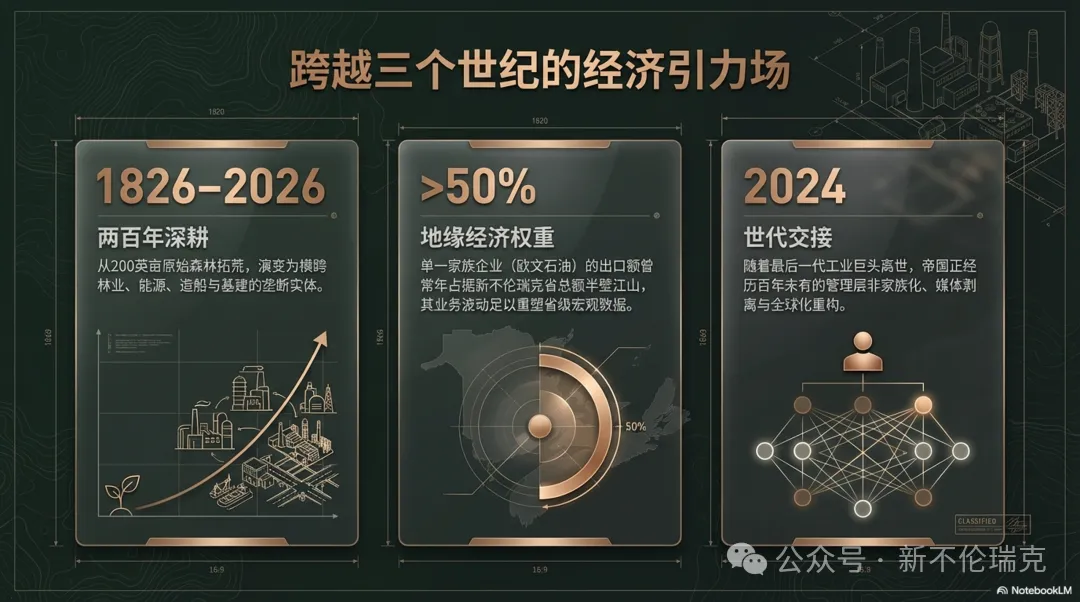
This report examines in depth the urban legend that "an Irving accountant's error moved the national GDP", confirming that the incident was in fact an IT failure at Statistics Canada — but also confirming, from another angle, the astonishing fact that a single month's output from Irving Oil is enough to move provincial and even national economic data. At the same time, while enjoying great political influence, the family has long faced social controversy over environmental pollution and the use of offshore companies to avoid tax.
New directions in the post-Arthur era
Overall, the Irving family is evolving from a traditional "patriarchal industrial kingdom" into a "globalized capital group". Despite the many controversies, against the background of the global low-carbon transition, its green-energy investments worth tens of billions of dollars will still directly determine New Brunswick's economic lifeline for decades to come.
Full Article
The Irving family is not only a symbol of wealth, but an industrial regime spanning three centuries, its influence deeply embedded in every inch of land, every tree and every drop of oil in New Brunswick. Through extremely complex vertical integration and diversified operations, the family built a vast empire that academics and politicians have called a "parallel government". For anyone seeking to understand the social structure, economic pulse and political dynamics of Atlantic Canada, the Irving family is a core subject that cannot be avoided. This report aims, on the basis of the latest archival material, business developments and geographical research, to analyse in detail the most influential family in Canadian history.
Chapter 1: The Family's Origins and the Historical Logic of Its Early Ventures (1826–1920)
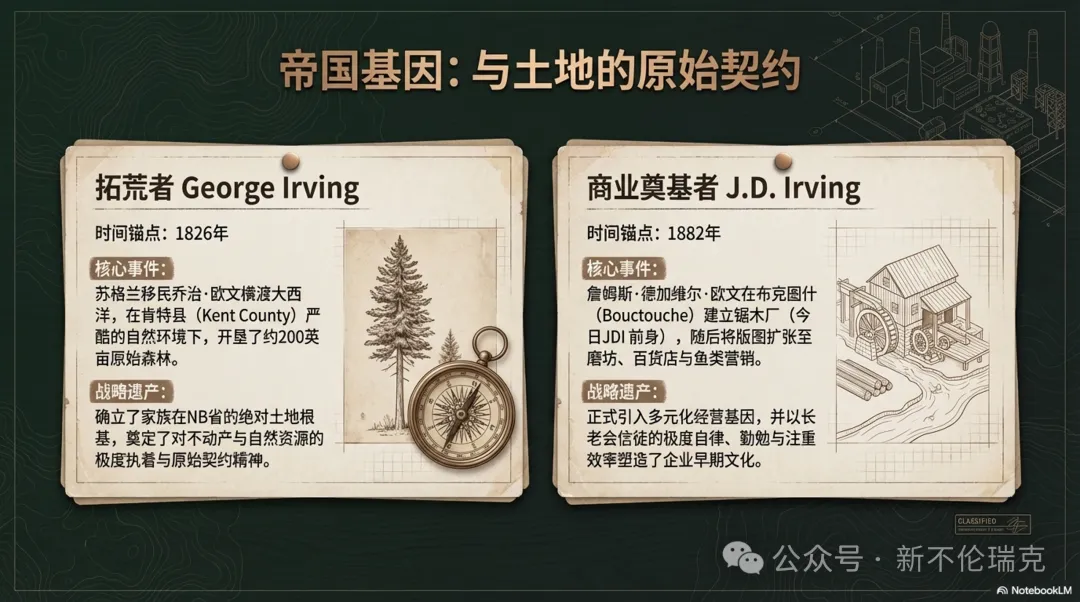
The rise of the Irving family is a microcosm of the nineteenth-century Scottish immigrant story. In 1826, George Irving left Dumfries, Scotland, crossed the Atlantic to New Brunswick, and cleared about 200 acres of virgin forest in Kent County 1. The early Irvings were typical pioneers, laying the family's foundations for survival through farming and the extraction of primary resources in a harsh natural environment. This original compact with the land shaped the family's later extreme attachment to real estate and natural resources.
1.1 James Dergavel (J.D.) Irving: The Founder of the Family's Business DNA
The man who truly brought the family onto the modern commercial stage was George's grandson, James Dergavel Irving, usually known as J.D. Irving. In 1882, J.D. Irving established a sawmill in Bouctouche, marking the formal birth of today's vast J.D. Irving, Limited 1.
J.D. Irving was a born innovator and diversifier. Over the decades from the late nineteenth century into the early twentieth, he expanded beyond timber into flour mills, carding mills, general stores, farms and fish marketing, among other fields 1. A devout Presbyterian, J.D. Irving held to values of extreme self-discipline, diligence and attention to efficiency. That discipline showed not only in his personal life but became the core gene of the Irving family's corporate culture. His first wife, Minnie Hutchinson, came from a wealthy local family, and his second wife, Mary Gifford, likewise brought the family important social connections 3.
1.2 Kenneth Colin (K.C.) Irving: The Master Architect of the Industrial Empire
If J.D. Irving laid the foundations, his son Kenneth Colin Irving, known as K.C. Irving, was the true empire-builder. K.C. Irving was born in 1899 and tried in his youth to enlist in the First World War; although the war ended before he completed flight training, his time in the Royal Flying Corps honed his decisiveness 1.
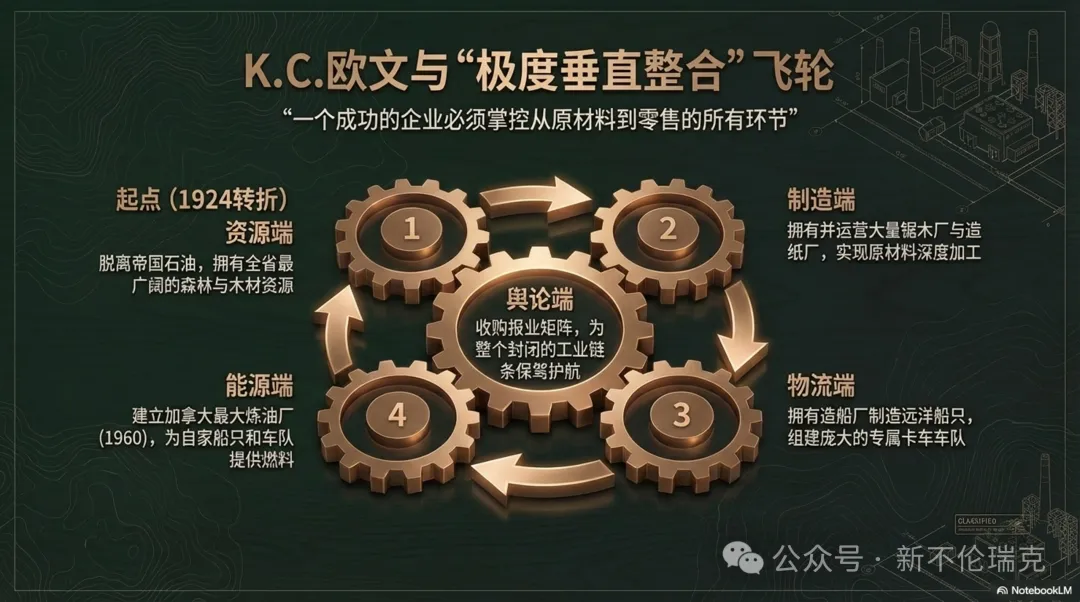
1924 was a key turning point in the Irving family's history. K.C. Irving, then running a Ford dealership and gas station in Bouctouche, fell into a dispute with the oil giant of the day, Imperial Oil, and resolutely decided to stop acting as its agent, instead importing gasoline directly from the United States and installing his own storage tanks 1. That move marked the beginning of Irving Oil. In 1925, K.C. moved to Saint John and rapidly expanded the business into buses, trucking, shipbuilding and various forms of industrial manufacturing. K.C. Irving firmly believed that a successful enterprise should own every link in the chain, from obtaining raw materials through processing and logistics to final retail — and this idea of "extreme vertical integration" became the guiding principle of his expansion.
| Key Year | Historical Event | Strategic Significance |
|---|---|---|
| 1826 | George Irving settles in Kent County | Establishes the family's land base in New Brunswick 1 |
| 1882 | J.D. Irving opens a sawmill in Bouctouche | J.D. Irving, Limited formally founded 1 |
| 1924 | K.C. Irving founds Irving Oil | Entry into the energy industry; the start of the vertical-integration road 1 |
| 1933 | K.C. Irving inherits J.D. Irving, Limited | The energy and forestry divisions converge strategically 1 |
| 1960 | The Saint John refinery officially opens | Canada's largest crude-oil processing centre established 1 |
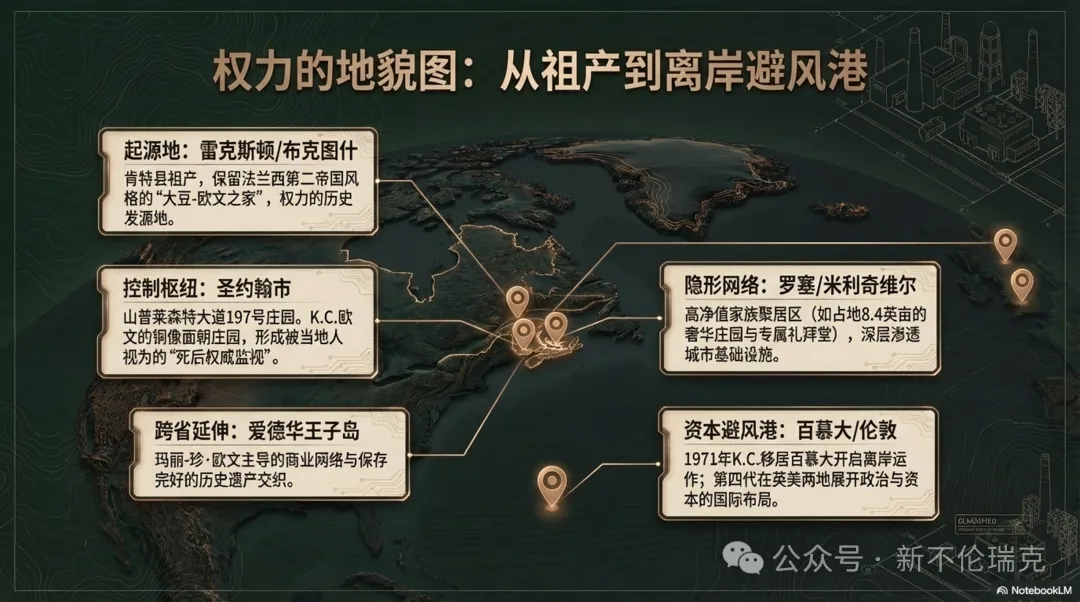
| 1971 | K.C. Irving moves to Bermuda | The start of decades of offshore asset operations 7 |
Chapter 2: A Deep Scan of the Family's Residences and Geographical Footprint
The Irving family's residences are not only the spaces of their personal lives, but the geographical coordinates of their distribution of power. From the first wilderness settlement to the world's most exclusive wealthy communities, their residential history reflects the trajectory of wealth accumulation and their subtle control over local communities.
2.1 The Ancestral Property in Kent County: Rexton and Bouctouche
The Irving family's roots remain firmly tied to Kent County. The "Soy-Irving House" at 1 Water Street, Rexton, is a witness to the family's early prosperity 10. The building is a typical French Second Empire structure, built in the mid-nineteenth century, with a mansard roof and fine exterior decoration.
The property was owned by Herbert Irving (J.D. Irving's father) from 1861 to 1891, and was extremely luxurious, reflecting the social standing of lumber merchants at the time 10. In addition, the family of K.C. Irving's wife, Harriet McNarin, ran the well-known McNarin Lodge in Rexton, and this marriage between families further consolidated the Irving family's social capital in the area 10.
2.2 The Power Coordinates of Saint John: Mount Pleasant Avenue and the City Centre
As K.C. Irving shifted the centre of his business to Saint John, the city's Mount Pleasant Avenue became the family's political and economic hub.
The estate at 197 Mount Pleasant Avenue: This was once K.C. Irving's principal residence, later inherited by his second son Arthur Irving, who lived there for many years 11. The mansion sits on a ridge overlooking the City of Saint John, symbolizing the family's dominion over the city 14.
The geographical gaze: In a small park across from the 197 estate, the family erected a bronze statue of K.C. Irving. The statue's face looks directly toward the mansion — an arrangement that local residents see as a form of "authoritative surveillance" maintained even after death 11.
Loyalist House: This landmark building at 120 Union Street, Saint John, was purchased by K.C. Irving in 1958 and then donated to the New Brunswick Historical Society and opened as a museum 15. The gesture was not only cultural philanthropy; it also reflected the family's attempt to tie its own history to the early immigration history of Canada (the Loyalists) 16.
2.3 Rothesay and Millidgeville: The Wealthy Social Circle
The affluent communities around Saint John are the main places where the family's middle and younger generations live.
Rothesay: Here lies a core property of the J.K. Irving family in Rothesay. The 8.4-acre estate has more than 21,000 square feet of living space and was designed by the noted architect Gordon Ridgely 18. Its interior is extremely luxurious, including 8 bedrooms, 15 bathrooms, a private library, a conservatory, and a well-preserved historic chapel (Netherwood Chapel) 18. In 2024, the memorial service after J.K. Irving's death was held here 21.
Millidgeville: This area is closer to the Saint John Regional Hospital and the university, and is a residential area for professionals. The Irving family owns large tracts of land here and once donated part of it for the construction of the city's fire-training centre 1.
New Hampshire and London: Fourth-generation member Jamie Irving shows stronger international mobility. Records show he has projects in Meredith, New Hampshire, in the United States, and is deeply involved in the local natural-resources conservation committee 24. He also holds directorships in private companies in London, England 27.
2.4 The Extension into Prince Edward Island (PEI)
The Irving family also has a deep residential and commercial footprint in the neighbouring province of PEI. Mary Jean Irving is a major figure in PEI's business world; although she grew up in New Brunswick, her business centre and some of her residences are in PEI, and her family purchased the famous "Irving House" in Union as early as 1903 — a house that remains a well-preserved Second Empire heritage property in the area to this day 28.
Chapter 3: The Irving Business Empire's Transformation and Strategic Restructuring in the 21st Century
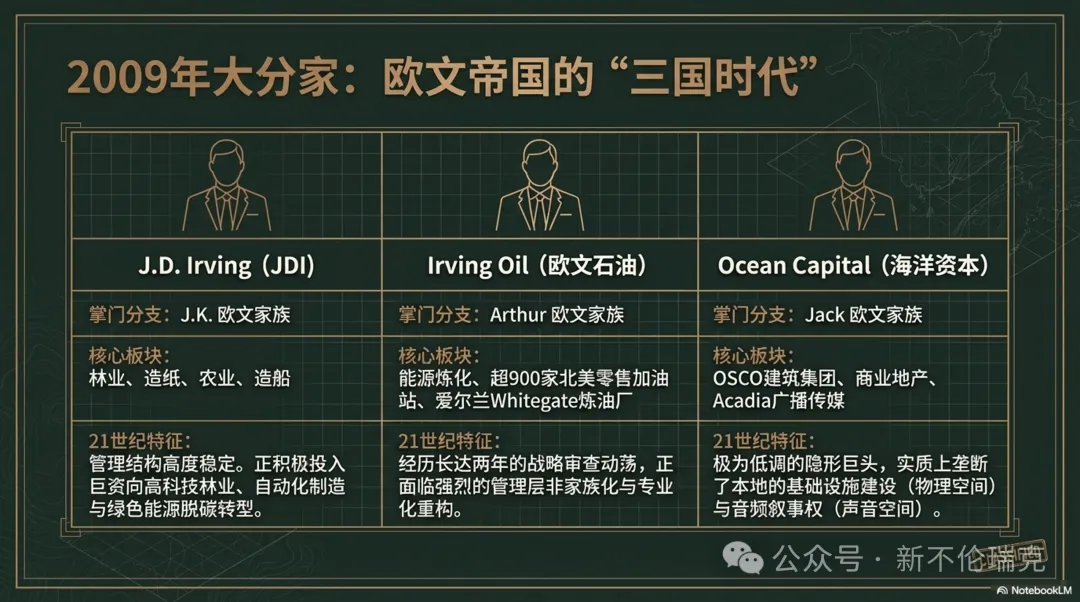
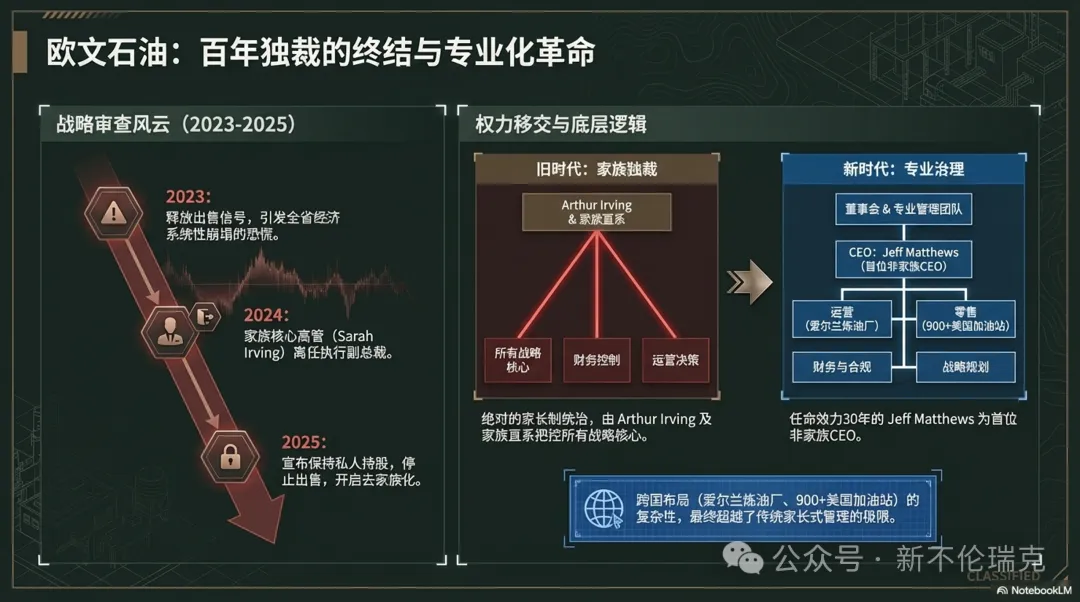
In 2009, the three Irving brothers (J.K., Arthur and Jack) formally reached a division agreement, ending decades of cross-shareholding 1. Entering the second decade of the twenty-first century, with the three brothers passing away one after another (Jack died in 2010, and both Arthur and J.K. died in 2024), the Irving empire is facing the most dramatic management transformation in a century 1.
3.1 Irving Oil: From Family Dictatorship to Professional Management
As the jewel in the family's crown, Irving Oil operates Canada's largest refinery. Between 2023 and 2025, the company went through a "strategic review" that touched the economic nerves of the whole province 6.
The sale rumours: The review initially sent signals that all or part of the assets might be sold. Because the refinery accounts for more than 50% of New Brunswick's total exports, a transfer of ownership out of the province could have caused a systemic collapse of the regional economy 1.
The outcome: In January 2025, the company announced the review was complete and confirmed it would remain privately held and would not be sold. The management, however, underwent a revolutionary change: because Arthur's daughter Sarah Irving had left her position as executive vice-president at the end of 2023, the company appointed Jeff Matthews, who had worked at the company for 30 years, as president and CEO 32. This was the first time in Irving Oil's history that a non-family member took the helm, marking its forced transformation toward a modern corporate governance structure 6.
The multinational footprint: Irving Oil acquired Ireland's only refinery (Whitegate) in 2014, and now owns more than 900 gas stations in the northeastern United States; the internationalization of its business has gone far beyond the era of the founders 1.
3.2 J.D. Irving, Limited (JDI): The Digital Upgrade of Forestry and Manufacturing
The JDI division, controlled by the J.K. Irving family, has shown stronger management stability. Brothers Jim and Robert, as co-CEOs, are pushing the company toward high-tech forestry and renewable energy 1.
| Project | Investment Scale / Objective | Strategic Logic |
|---|---|---|
| Project NextGen | Saint John pulp mill upgrade 37 | Aims to create the world's most efficient and environmentally friendly kraft pulp production base; construction planned to start in 2025. |
| Brighton Mountain Wind Farm | Green energy supply 37 | Building a large wind farm in western New Brunswick to provide decarbonization support for the local power grid. |
| Macon Tissue Mill Expansion | C$600 million 37 | Deepening the manufacturing footprint in Georgia and increasing market share in the North American consumer-products market. |
| One Billion Trees Program | Ecological restoration 1 | Ensuring the sustainability of the raw-material supply chain through large-scale artificial afforestation. |
3.3 Ocean Capital: The Diversification of a Hidden Giant
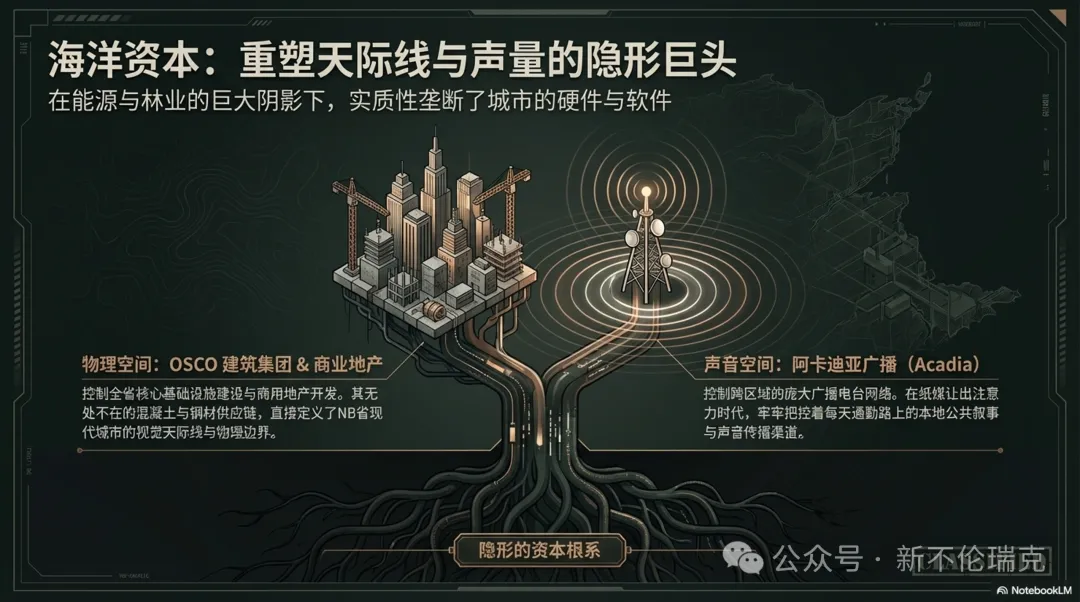
Ocean Capital, led by the Jack Irving family, looks low-key beneath the enormous shadow of energy and forestry, but holds a monopolistic advantage in local infrastructure. Its OSCO construction group and commercial real-estate companies define New Brunswick's city skylines, while Acadia Broadcasting controls important audio narrative power across the province 1.
Chapter 4: The End of the Newspaper Monopoly and the Deconstruction of Media Hegemony
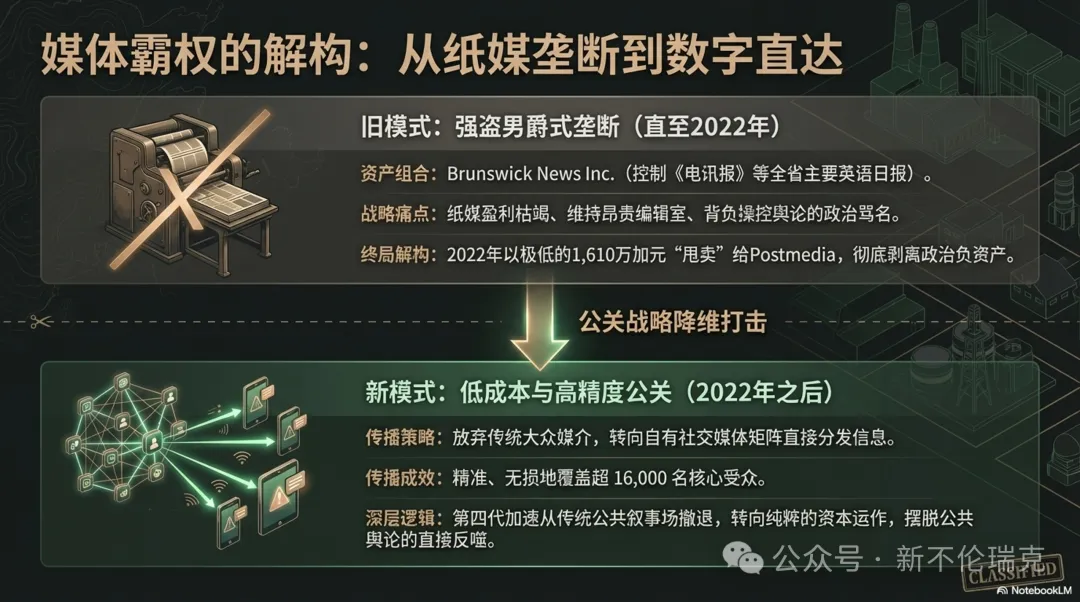
The Irving family's control of the media was once described by Le Monde as a "robber-baron-style" monopoly 1. But in 2022, that pattern broke apart in a historic rupture.
4.1 Divesting the Print Media Assets: The Postmedia Deal
In February 2022, J.D. Irving, Limited announced the sale of its Brunswick News Inc. (BNI) to Postmedia in its entirety 42.
Deal details: The sale price was only C$16.1 million, covering all the province's major English-language daily newspapers (such as the Telegraph-Journal and the Daily Gleaner) 42.
The logic of the exit: The Irving family had long been accused of using its newspapers as a cheerleading squad for its industrial interests. However, as the profitability of print media dried up and social media rose, maintaining a loss-making media entity carrying the stigma of "manipulating public opinion" was no longer worthwhile. JDI can now reach more than 16,000 core followers through direct social-media operations, at lower cost and with greater flexibility, without maintaining an expensive newsroom 44.
Jamie Irving's change of role: After the deal closed, Jamie Irving served for a time as executive chair of the Postmedia board, but suddenly resigned in June 2023. Observers believe this may signal that the family's fourth generation is accelerating its retreat from the traditional public-narrative field, turning toward purer capital operations and international investment 42.
Chapter 5: A Deep Analysis of the Urban Legend: The Accounting Error and the Mystery of the GDP Revision
In Canadian economic circles, the story that "an Irving Oil accountant wrote down the wrong number and moved the national GDP" has circulated widely. The legend is not only an anecdote, but a symbol of the extreme economic form of "a large company in a small province". By tracing the statistical data, we can reach a clearer conclusion than before.
5.1 The Confirmed Facts: The Real Background of the Statistical Revision
In 2011, Statistics Canada did indeed make a serious error in its provincial GDP calculations 48. The data as published showed abnormally weak economic performance in several provinces, including Saskatchewan and New Brunswick. Subsequently, following public questioning by RBC economist Robert Hogue, Statistics Canada made a dramatic revision two weeks later 48.
5.2 The Core Truth: An IT Failure, Not an Accounting Error
According to internal Statistics Canada investigation documents disclosed through the Access to Information Act, the 2011 revision was not caused by some Irving Oil accountant writing down the wrong number. The real cause was this: Statistics Canada was in the middle of a changeover between old and new data-processing systems, and, lacking adequate IT stress testing, the new data-crunching system reversed the order of two key steps during calculation 48.
5.3 The Logic Behind the Legend: Irving Oil's Statistical Weight
Although the specific 2011 incident had nothing to do with an Irving accountant, the claim that "Irving Oil is big enough to move the GDP" is statistically valid.
Export dependence: Irving Oil's annual exports once reached C$5 billion, more than half of New Brunswick's total exports. In some months, fluctuations in a single refinery's output could explain 80% of the difference in the province's industrial output 1.
The turnaround effect: Whenever the Saint John refinery enters a shutdown for maintenance (a "turnaround"), New Brunswick's monthly trade balance — and even Canada's quarterly GDP growth figures — show a visible "dip" 1.
Conclusion: There is indeed a complex "data-reporting game" between Irving Oil and the statistical agencies. The public's reduction of a complex systemic IT failure to an "accountant's slip" is in fact a psychological projection of the Irving family's power — in an "Irving province", people would rather believe that any major event originates in the office on that hill than in a server failure in Ottawa.
Chapter 6: Family Legacy, Social Controversy and Political Capture
The Irving family's success has been accompanied by deep social fractures. In pursuing vertical integration, it has been accused of causing irreversible damage to New Brunswick's politics and environment.
6.1 Politics Under "Irving Dominance"
New Brunswick's political map is often described as a projection of Irving interests. Former premier Blaine Higgs worked as a logistics supervisor at Irving Oil for 33 years, only entering politics formally after retiring in 2010 1. This "revolving door" mechanism leaves the public questioning whether the government can truly remain neutral when setting timber quotas, energy taxes and environmental regulations. Critics point out that the Irving family often secures highly favourable terms on land-tax relief and forestry herbicide use (such as the glyphosate controversy) 1.
6.2 Environmental Record and Offshore Taxation
Environmental stain: Besides being the province's largest source of carbon emissions, the famous "Irving Whale" barge-sinking incident is a major liability in the family's environmental history. The barge sank and caused a large fuel leak, and the family's long wrangling over cleanup responsibility and cost-sharing weakened its moral standing in the environmental field 1.
Offshore haven: The Paradise Papers revealed that the Irving family used offshore shell companies in Bermuda, such as F.M.A. Ltd, for internal reinsurance transactions. This legal tax-avoidance method allowed the family to keep huge profits in a zero-tax jurisdiction, rather than fully investing them in the "home building" it repeatedly proclaims 57.
Chapter 7: Philanthropy and Cultural Support
Despite the controversies, the Irving family's investment in public facilities is also astonishing.
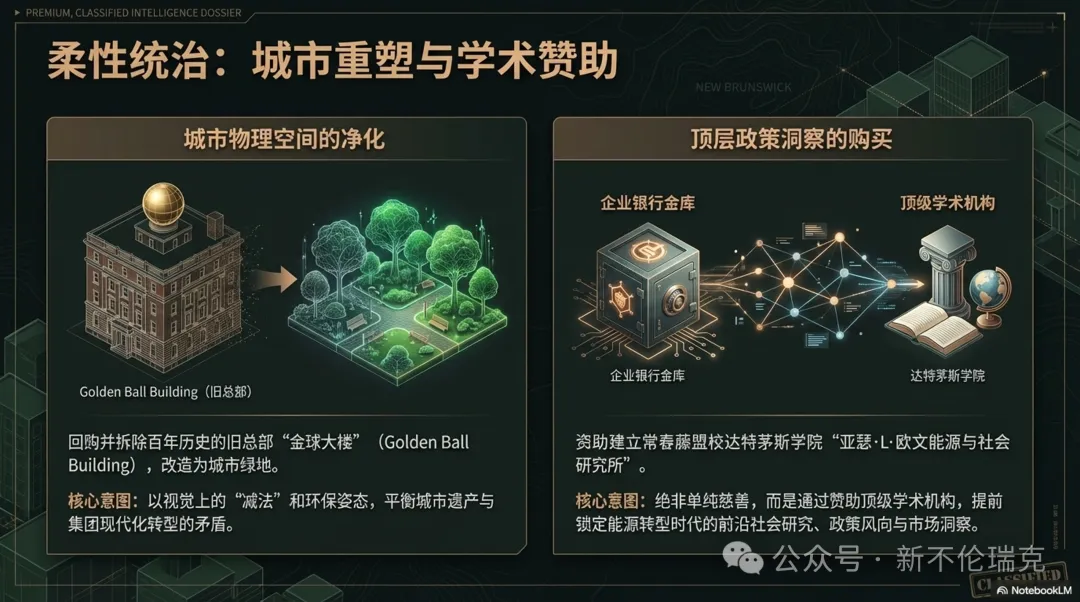
Updating a Saint John landmark: In 2025, JDI, the family's company, bought back the nearly century-old "Golden Ball Building". Although the building was Irving Oil's former headquarters, JDI decided to demolish it and temporarily keep the site as green space. This is seen as the family's latest case of balancing the heritage value of the city against the needs of modern office space 58.
Funding for higher education: The Irving family's philanthropy is highly specialized. The Arthur L. Irving Institute for Energy and Society at Dartmouth College is dedicated to studying the impact of the energy transition on society, which in practice also provides the family businesses with cutting-edge policy and market insight 1.
Chapter 8: Conclusion — The Irving Empire in the Post-Arthur Era
The deaths in 2024 of the last two giants among the three Irving brothers marked the end of an era 1. As the fourth generation pursues different career paths and Irving Oil begins to appoint non-family executives, the Irving family is evolving from a "patriarchal industrial kingdom" into a "globalized capital group".

For people about to settle in New Brunswick, or already living there, understanding the Irving family is no longer a simple matter of "admiration or criticism". It is both the apex predator in the province's economic ecosystem and its most stable employer 1. As the world transitions to a low-carbon economy, the investments of Irving Oil and JDI in green energy, worth billions of Canadian dollars (such as Project NextGen and wind farms), will directly determine the economic resilience of the Atlantic coast for the next thirty years 31. The history of the Irving family is a story of survival written on land, in newspapers, on oil tanks and in legal documents — and it will continue to define the boundaries of New Brunswick.
Cited Works
Irving Family History Research Report: Irving History, http://irving-fam.com/tng/histories/Irving%20History.pdf
Irving family (New Brunswick) - Wikipedia, https://en.wikipedia.org/wiki/Irving_family_(New_Brunswick)
K. C. Irving - Wikipedia, https://en.wikipedia.org/wiki/K._C._Irving
After strategic review, New Brunswick's Irving Oil to remain privately held, https://halifax.citynews.ca/2025/01/15/new-brunswicks-irving-oil-to-remain-privately-held-company-strategic-review/
Irving Oil announces company won't be sold, ending nearly 2 years, https://www.cbc.ca/news/canada/new-brunswick/irving-oil-will-not-be-sold-1.7431218
Bye bye, Bermuda? - CBC, https://www.cbc.ca/newsinteractives/features/bye-bye-bermuda
Irving Oil concludes strategic review and announces new President and CEO, https://www.irvingoil.com/en-CA/press-room/irving-oil-concludes-strategic-review-and-announces-new-president-ceo
Skipped computer test blamed for StatsCan error | CBC News, https://www.cbc.ca/news/science/skipped-computer-test-blamed-for-statscan-error-1.1024847
How Irving's Bermuda insurance company piled up millions in ... - CBC, https://www.cbc.ca/news/canada/new-brunswick/irving-paradise-papers-1.6628921
Irving Oil's 'Golden Ball' building sold, could be demolished, https://www.ctvnews.ca/atlantic/new-brunswick/article/irving-oils-golden-ball-building-sold-could-be-demolished/
This article was originally published on the WeChat public account 「新不伦瑞克」 (New Brunswick Today); original link: mp.weixin.qq.com/s?__biz=MzI4Mjc3NDcyMg==&mid=2247485405&idx=1&sn=8576b97137151988200b8a8869e7c6cf&chksm=eb959a70dce213662e72753c8628d7531eec627888b7264c58728de1bf9581aaa4c910566b3f&scene=178&cur_album_id=4378684396283723780&search_click_id=